The ongoing conflict in Middle East and disruptions at the Strait of Hormuz have exposed India’s heavy reliance on imported gas. Strait of Hormuz has become a critical chokepoint, with more than 20% of global energy supplies passing through the strait. Seeing the current scenario, the Centre has invoked the Essential Commodities Act, 1955 to reallocate gas supplies. India is the world’s fourth largest importer of liquefied natural gas (LNG). India is not entirely dependent on imports. India’s total domestic gas production reached 36.4 billion cubic metres (bcm) in 2023, meeting roughly half of the country’s gas demand. Tensions due to war has led to disruptions in liquefied petroleum gas (LPG) supply, raising prices of commercial LPG cylinders in India.
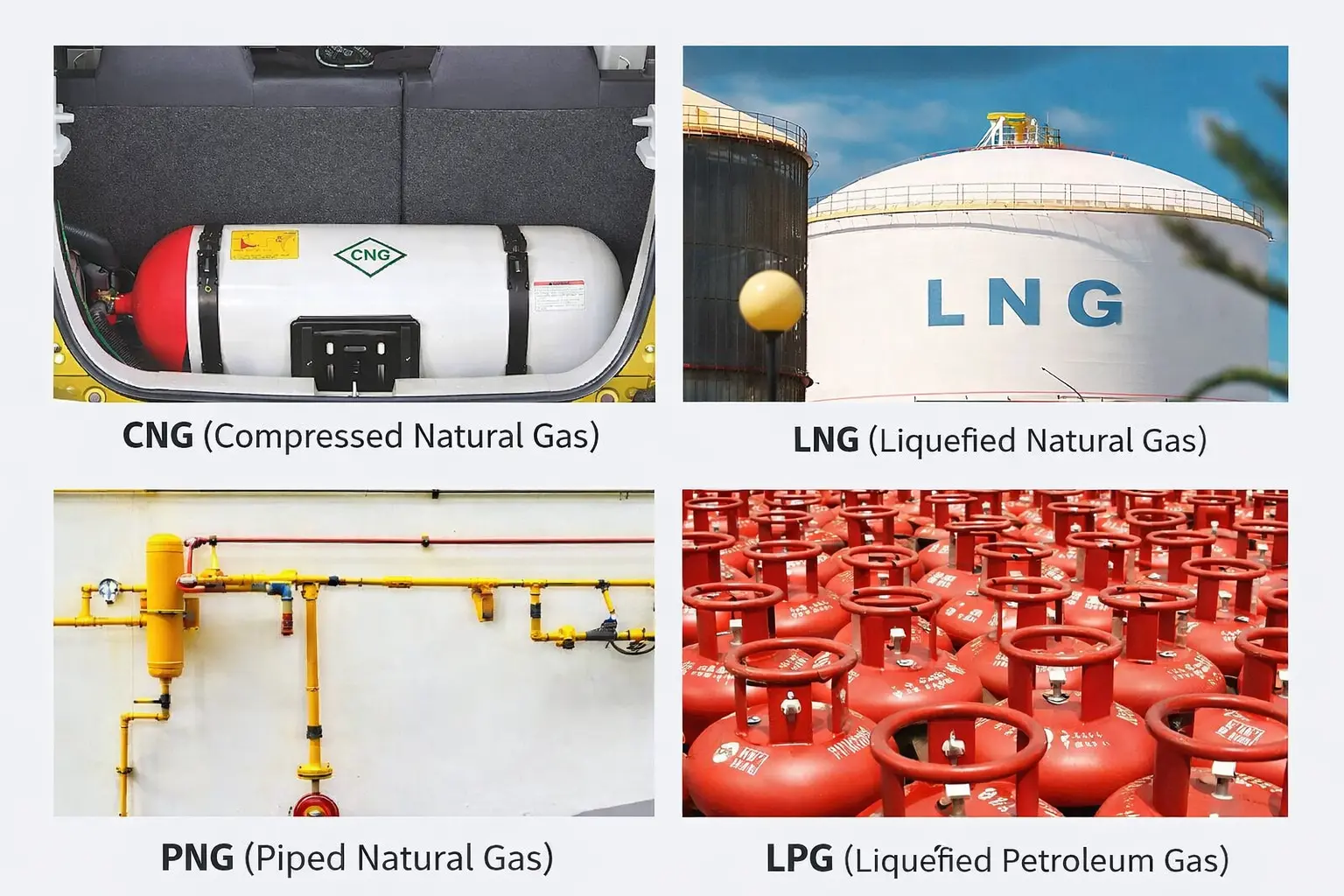
In most of the Indian households, the red LPG cylinder can be found in the kitchens. Some city commuters fill their vehicles with Compressed Natural Gas (CNG). Now, in many urban households, Piped Natural Gas (PNG) can be found, which is used for the same purpose as LPG i.e. cooking. Whereas, LNG is used to fuel industries and power plants. LPG, LNG, CNG, PNG all the names sound similar, but they serve different purposes. Altogether, they form an important part of India’s growing economy.
Liquefied Petroleum Gas (LPG)
Cooking begins with LPG in millions of households. It is produced during the refining of crude oil and processing of natural gas. LPG is a portable, clean, and efficient energy source composed mainly of propane and butane gases, which are compressed into liquid form and stored into cylinders. India produces some LPG domestically, but most of the demand is fulfilled through imports.
The government has expanded access through programmes like Pradhan Mantri Ujjwala Yojana, which provided subsidised LPG connections to low-income households. LPG is portable and thus reaches the last village of India as well. The cylinders can be transported easily anywhere- from rural homes to eateries. India imports LPG from six major suppliers: Qatar, the UAE, Kuwait, Saudi Arabia, Oman and the United States.
LPG is hevaier than air and thus settles down in low-lying areas like floors, basements, or drains, increasing risks of fire or explosion if it encounters a spark.
Compressed Natural Gas (CNG)
CNG has become a common sight on city roads. It is environmentally friendly automotive fuel composed of methane (80%-90%). CNG is primarily used as a vehicle fuel. It is compressed at high pressures, allowing large amounts of gas to be stored in small vehicle tanks. It remains in gaseous form.
CNG is considered more clean when compared with petrol or diesel as burns more cleanly and produces fewer emissions. Due to this reason CNG is widely used to reduce vehicular greenhouse gas emissions and urban pollution.
Piped Natural Gas (PNG)
PNG is composed of methane, including other small hydrocarbons. It is a natural gas delivered directly through pipelines to homes, industries and commercial establishments. PNG burns more cleanly because methane has the lowest carbon-to-hydrogen ratio among fossil fuels.
The system works like a water connection in which gas flows through an underground pipeline network. A meter is installed at the respective site of the consumer and they pay based on usage recorded on the meter. It is more common in urban areas than the rural area. PNG eliminates the need for cylinders and ensures a steady supply of fuel. PNG is considered more safer than LPG as it is lighter than air and disperses quickly in a leak.
Liquefied Natural Gas (LNG)
LNG plays a different role in India’s energy supply chain. It is also a natural gas composed of methane, cooled to –162°C, turning it into liquid form. This reduces the volume drastically, making it easier to transport across long distances by ship. LNG is transported in specialized cryogenic tankers and stored in insulated tanks at terminals near ports. After arriving at the coastal terminals, the liquid gas is converted back into natural gas and transported through pipelines for use in electricity generation, fertilizer production, city gas distribution, and industrial processes.
Qatar has been India’s top supplier of LNG for decades. Other suppliers include the UAE, Oman, Australia, Russia, Nigeria and Algeria, giving India a reasonably diversified import portfolio. LNG is not directly consumed by households rather it is used as an energy source for power generation, heating, and industrial manufacturing.