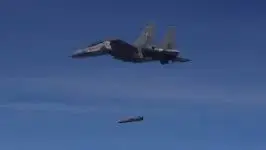
India has achieved a significant milestone in defence sector by conducting successful flight test of RudraM-II air-to-surface missile from an airborne platform from the Integrated Test Range (ITR), Chandipur.
The missile was guided to a predefined target with pin-point accuracy. Defence Minister Rajnath Singh has praised the efforts of DRDO, IAF and other agencies linked to the indegenous missile programme and the industry for the successful flight test.
RudraM-II Missile
RudraM is a series of indegenous air-to-surface missiles that are being developed to meet the Indian Air Force’s requirement for enhancing its Suppression of Enemy Air Defence (SEAD) capability.
It is an anti-radiation missile which is designed to target enemy radar, communication systems and other radio-frequency sources that form part of hostile air-defence networks. So far, three variants of RudraM missile, RudraM-I, RudraM-II and RudraM-III, have been developed, with comprehensive testing of the first and second variants carried out earlier.

RudraM-II has been indegenously developed by DRDO in collaboration with several other DRDO establishments.
Features of Rudram-II
- Its maximum speed can reach a peak speed of Mach 5.5.
- It is capable of striking targets at a distance of approximately 300 km.
- It can carry a warhead up to 200 kg.
- It can be deployed from aircraft flying at altitudes ranging from 3 to 15 km, Su-30MKI fighter aircraft.
- It is intended to eventually replace the older Russian-origin Kh-31 anti-radiation missiles and serving as a key force multiplier for the Indian Air Force.