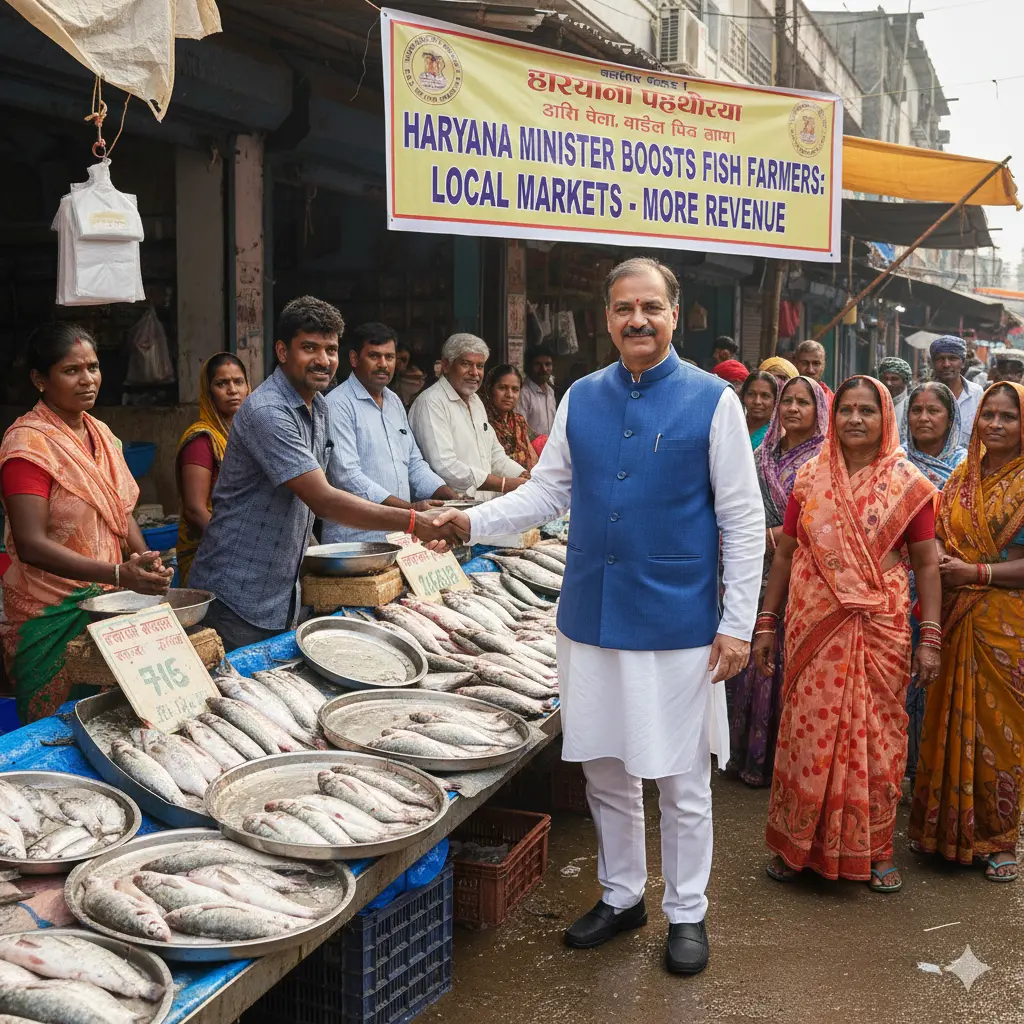
The Haryana Agriculture and Farmers Welfare Minister, Shyam Singh Rana, has instructed the official to develop an action plan on developing local markets around fish farms so that the transportation expenses can be reduced, and the earnings of the farmers can be increased directly. This plan was created in the context of pre-budget consultation on January 13, 2026, when the minister reiterated the necessity to match schemes with the vision of Prime Minister Narendra Modi to create Viksit Bharat 2047. The fisheries industry in Haryana is an industry that is already an industry leader with a production capacity of more than 2.04 lakh metric tonnes annually and therefore, the targeted interventions can help Haryana a lot.
Existing Problems of Fish Farmers.
In Haryana, fish farmers also experience huge losses since they have to travel miles to sell their harvest in the urban or district market. Harvests such as carp, rohu, and white shrimp that are emerging would do away with cold chains easily and would be sold at low prices to the middlemen. Districts like Bhiwani, Sirsa, Hisar and Kaithal have thousands of ponds on the waterlogged and saline lands but farmers find it difficult to market their products despite the high yield of scientific aquaculture. As suggested by Minister Rana, incomes are stifled without neighbouring outlets even though production is exploding under central schemes such as Pradhan Mantri Matsya Sampada Yojana (PMMSY).
Pond aeration and lighting are also costly in terms of electricity, which is further complicated by pollution. The Fisheries subsidies are applied to the Scheduled Caste families, which are major participants in fisheries but require an accelerated introduction of nets and infrastructure. The 25 cold storages that are in operation in the state can assist, and additional markets in Faridabad, Gurugram, and Hisar are suggested in order to address gaps in supply and demand.
The following characteristics are the main aspects of the suggested plan.
Rana asked the psychologists to prepare a roadmap in detail when the meeting was held with the Additional Chief Secretary Raja Sekhar Vundru, and the roadmap was to be on the budget utilisation in the previous year. The local markets would facilitate direct sales to the consumers, hotels and exporters without involving the middlemen who make 30-40% margins. Solar-powered lights at ponds are given priority and savings of up to 70 percent on bills are achieved as well as an end to diesel generator pollution. The Rs 98.90 crore project of an Integrated Aqua Park Centre of Excellence in Garwa (Bhiwani) and Sirsa will be the first of its kind to venture into white shrimp farming in salty water, and produce high-quality export products. The scheme is called Welfare of Scheduled Caste Families under the Fisheries Sector and provides 60 percent subsidies up to 40,000 on net purchase that should be rolled out immediately. The officials should make sure that all schemes are triggered quickly, aiming to achieve double incomes by means of enhanced marketing and value addition.
Fisheries Growth in Haryana
Haryana has been able to become the largest inland fish producer in India with the help of large seed farms and biofloc technology. The 11,000-plus hectares of ponds produce 2.04 lakh tonnes annually with the aid of PMMSY funds on the shrimp and ornamental fish. There are already 25 cold storages, and the number is going to be increased with the district-level market and storage to reach the peak harvests. Kisan Credit Card Subsidies in fisheries open saline lands that provide employment to more than 50,000 families.
The push of the minister is consistent with the country’s objectives: fish production reached 197.75 lakh tonnes in FY 2024-25, which is twice as high as the level of 2013-14. Training centres and quality feeds have helped Haryana to be the top in the country in per-hectare productivity of 18-20 tonnes, which is well above the 3-tonne national average.
Economic Impact on Rural Haryana.
The local markets have the potential for transformative gains. A farmer who sells 5 tonnes in a week in a local outlet may earn in the range of Rs 2-3 lakh every month (after the deductions of transport). A 20 percent more value is retained through reduced spoilage through on-site cold chains. New aqua parks are aiming at exporting shrimps worth Rs 1 lakh crore to the country by 2025 and Haryana is hoping to get an inclusive portion of this share with the saline experience of Sirsa.
This is followed by job creation: markets require loaders, cleaners, and retailers, which enhance the livelihoods of rural women and young people. Solar projects reduce expenses by 10,000 per pond every year which can be used to expand the programs. The merger between HSAMB and mandis is guaranteed, which allows quality checks and reasonable price levels, bridging farmers and the demand in the Delhi-NCR.
State Programs and Grants.
PMMSY directs an amount of Rs 20,050 crore to the country with the Haryana state tapping into ponds, hatcheries, and training. The state schemes provide 40-60% subsidies on liners, aerators, and biofloc units. SC/ST focus offers additional assistance whereas PM Dhan-Dhaanya Krishi Yojana supports aspirational districts.
The requirements of the directives by Rana include pre-budget funding proposals and a focus on markets and solarisation. With fast-tracking, the farmers will have reaped by the 2026-27 fiscal year.
Directions to Sustainable Fisheries.
This strategy makes Haryana a fisheries hub, a mixed strategy of local empowerment and export goals. Incomes would increase by half within two years by eliminating middlemen and expenses. The issues such as water shortage require integration of rainwater harvesting.
Meetings of farmers cooperatives with stakeholders will sharpen locations making sure that they are viable. Execution is everything: the introduction of cold storage in the past reduced losses by 15%. Fish farmers are looking forward to a sector that is going to be springboarding to Viksit Haryana, as Budget 2026-27 approaches.
The vision of Minister Rana transforms ponds into profit centres and demonstrates that targeted markets open up the wealth of the rural regions. Haryana fish farmers are preparing successfully to enjoy a healthy crop in future due to action plans in place.