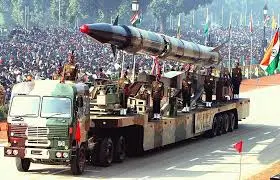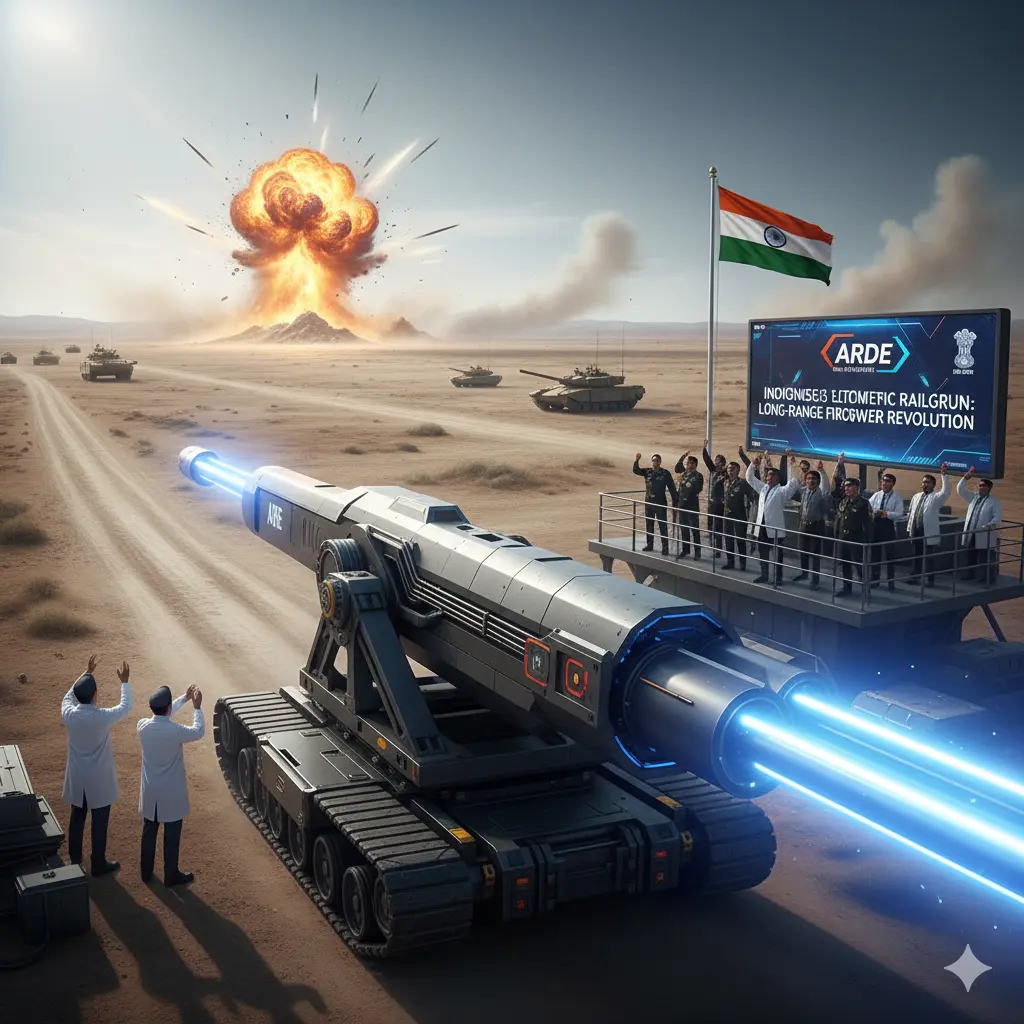
Official confirmation of an indigenous Electromagnetic Railgun system has been announced by India Armament Research and Development Establishment (ARDE) and this places the Indian Army in a quantum leap towards long-range precision artillery. ARDE Chief Ankathi Raju described it as one of our most ambitious projects, which will utilize electricity to propel 50kg projectiles at mach 6 (2,000 m/s) at a range of more than 200km, without having chemical propellants at all. This puts India on par with the US, China and Japan in the next-generation directed energy weaponry
The Railgun Technology: Kinetic Revolution.
Railguns, unlike the gunpowder cannon, produce huge kinetic energies through electromagnetic Lorentz force. It uses 11,000V/2.5 mega-amps of current in two parallel conducting rails that accelerate metal slugs with the help of plasma armatures. It did not require any explosives–terminal impact destroys at a mere hypersonic speed.
Key advantages:
| Parameter | Railgun | Conventional Artillery |
| Velocity of muzzle | Mach 6 (2km/s) | Mach 2.5 (850m/s) |
| Range | 200km | 40-80km |
| Weight of projectile | 50kg | 45kg |
| Logistics | Solid metal shot | Blasting shells |
| Cost/Shot | ₹50,000 | ₹2-5 lakh |
CEMaLT plant in Pune is based on a 10MJ lab test scale with a 100M J field-ready. Cleared 2025 validation was done by high-power capacitors, durable rail alloys (resisting 1,000C plasma), and pulsed power sources.
Indian Army Strategic Game-Changer.
Two-front deterrence: 200km range is able to provide full cover of Tibet Autonomous Region at the position of Ladakh, and PCL-1810 (150km) of China cannot. M110A2 (30km) of Pakistan gets outdated. No muzzle flash (silent operation) allows deep attacks in the C4ISR nodes, ammunition dumps, airfields.
Integration roadmap:
- 2028: Mobile prototypes (8×8 Ashok Leyland platforms).
- 2032: 50 systems in Northern/Western Commands.
- Network-centric: Connections with IACCS, Project Kusha SAMs.
Potential swarm: S-400/PL-15 is saturated with 20-railgun batteries, which complement BrahMos/Nagastra drone strikes.
Technical Barriers overcome.
Power challenge: Lithium-sulfur (32MJ) batteries can provide 100 shots and recharge; solar-hybrid generators can keep the operations going. Rail erosion Tungsten-carbide composites survive 500 rounds; liquid-cooled rails absorb 10GW heat.
Precision: GPS/INS guidance provides CEP of less than 10m; barrel rifling provides spin stability. Machine 5+ speed was confirmed byARDE during Kiran MkII trials (2024).
Atmanirbhar Bharat Millstone.
100 percent localized: ARDE is the leader; Tata power (capacitors) and L&T (rails) and BEL (guidance) are the leaders. 5 crore Phase-I generates 2,000 jobs; QUAD exports targeted after 2030.
International reputation: The US Navy put shelved railguns (2021); the Chinese prototype is at 150km. The fielding of the 50MJ tests in Japan follow the Indian fielding schedule.
Army Doctrine Evolution
Railguns are combined with 155mm/52cal howitzers (K9, ATAGS) in Field Artillery Rationalization. Targets are fed in real-time by Mobile Counter-Battery Radar networks. Logistics made easy- no ammo trains required.
Altitude test: Ladakh test 2027; -40C operation approved. Para SF Urban warfare variant (10km range) follows.
Geopolitical Power Shift
Hypersonic guns of China are countered; neutralized Pakistani A-100. Railgun rejects PLA positions in Aksai Chin, capturing LAC.
Budget synergy Defence outlay increases to ₹6.5 lakh crore; railgun consumes 2%. iDEX startups provide AI targeting algorithms.
Raju vision: “Chemical to electrical warfare paradigm shift-India First. At the end of the decade, ARDE is providing silent thunder – kinetic dominance that will transform artillery permanently.