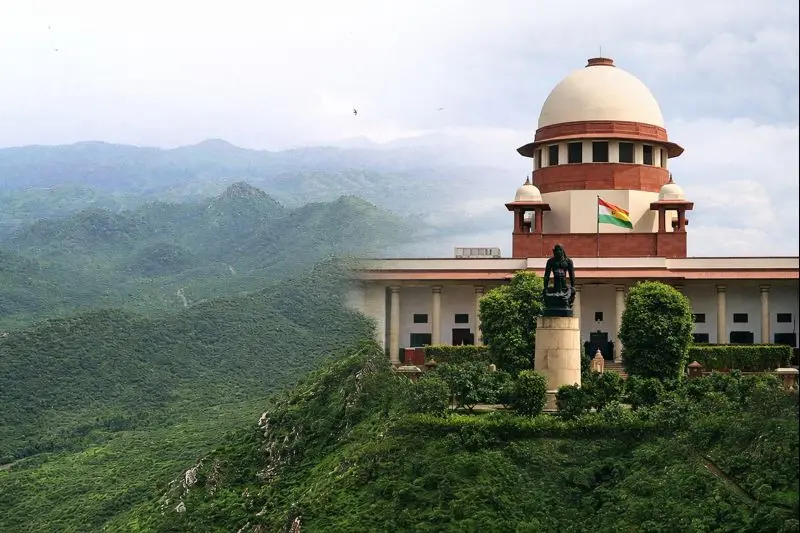
Supreme Court orders formation of high-powered expert committee.
After prolonged protests over Aravalli Hills and Ranges, the SC on Monday (December 29, 2025) kept its earlier order in abeyance, defining the Aravalli hills and ranges. It observed that the recommendations of the expert committee appointed by the Court had been misconstrued. The report submitted by the committee on November 20, 2025 had led to confusion particularly over its implications for mining activities in the Aravalli region. The court took suo motu cognisance on December 28, 2025 and ordered an urgent hearing the following day, over protests and concerns raised by environmental groups, NGOs, and civil society organizations over the revised definition of the Aravalli Hills. States such as Haryana, Rajasthan, Gujarat and National Capital Territory of Delhi saw widespread demonstrations against the court’s order. As per the accepted definition, the hills above 100 meters would be protected and an “Aravalli Range” is formed when two or more such hills are located within 500 metres of each other, which meant over 90% of the Aravalli Range was left to illegal mining and destruction by private owners. The earlier directions had also required the central government to prepare a Management Plan for Sustainable Mining (MPSM) for the entire Aravalli range.
A Bench comprising Chief Justice of India Surya Kant, Justice J.K. Maheshwari and Justice A.G. Masih flagged specific concerns requiring examination, including whether regulated mining would be permitted in the 500-metre gaps between hills and if so, what precise structural parameters would be used to ensure that ecological continuity was not compromised. The Supreme Court has ordered the formation of a high-powered, independent expert committee to holistically assess the report and examine these questions. The court has also requested the Attorney General for India R Venkataramani and Senior Advocate P.S. Parmeswar to assist the Court, including on the composition of the proposed committee.