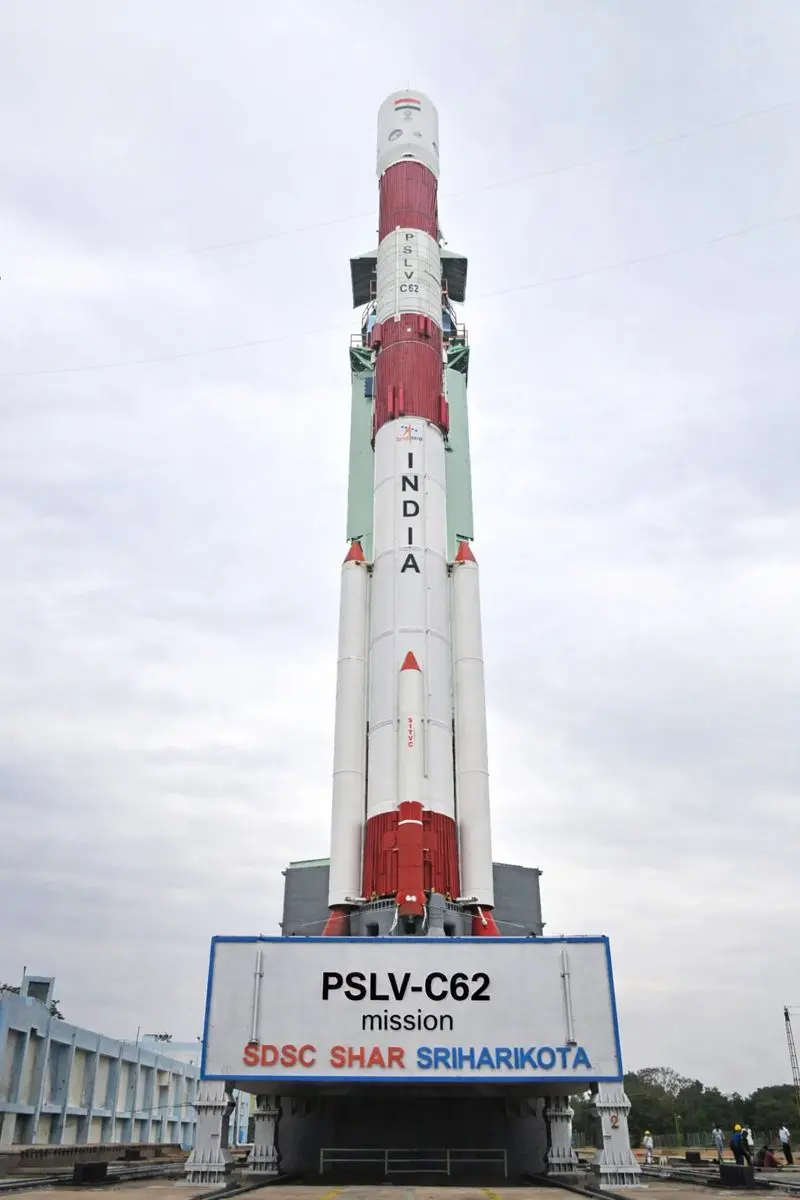
The Indian Space Research Organization’s (ISRO) first space launch of the year suffered a major setback, with all 16 satellites lost despite a spectacular liftoff from Sriharikota on January 12, 2026. This was 105th launch from Sriharikota and 64th flight of the Polar Satellite Launch Vehicle. The Polar Satellite Launch Vehicle (PSLV) was carrying an earth observation satellite and 15 co-passenger satellites, developed by start-ups and academic institutions from India and abroad. The launch used the 260-tonne PSLV-DL variant with two solid strap-on motors which took off at 10:17 AM IST. PSLV-C62 mission experienced an anomaly at the end of the PS3 stage. ISRO confirmed the flight deviation and has initiated a detailed analysis on the mishap.
What was the PSLV-C62 mission?
The mission aimed for a 505 km sun-synchronous orbit, carrying DRDO’s EOS-N1 (Anvesha) primary satellite for maritime surveillance alongside 15 co-passengers, including Indian student payloads, private firm experiments, and Spain’s KID re-entry demonstrator. The mission’s primary payload was the earth observation satellite EOS-N1 (codenamed Anvesha), a hyperspectral imaging satellite for maritime surveillance, which makes it a high-value asset for national security, border surveillance and strategic monitoring. It was also meant to support civilian applications such as agriculture planning, urban mapping, mineral detection, and environmental monitoring. PSLV-C62 carries Europe’s Kestrel Initial Demonstrator (KID), an experimental mission involving a small re-entry capsule developed in collaboration with a Spanish startup.
The 15 co-passengers are: CGUSAT by Dhruva Space (India); Theos-2 earth observation satellite built jointly by Thailand and the U.K.; MOI-1 by Dhruva Space and Takeme2Space (India); DSUSAT by Dhruva Space; LACHIT by Dhruva Space and and Don Bosco University (India); Munal by Nepal university Antharkshya Pratishtan (Nepal) and MEA, GoI; Thybolt-3 by Dhruva Space; KID Capsule by Orbital Paradigm (Spain) and RIDE! (France); Edusat by AlltoSpace (Brazil); Galaxy Explorer by AlltoSpace; Uaisat by AlltoSpace; Orbital Temple by AlltoSpace; AyulSat by OrbitAid (India) and Sanskarsat by Laxman Gyanpith (India).