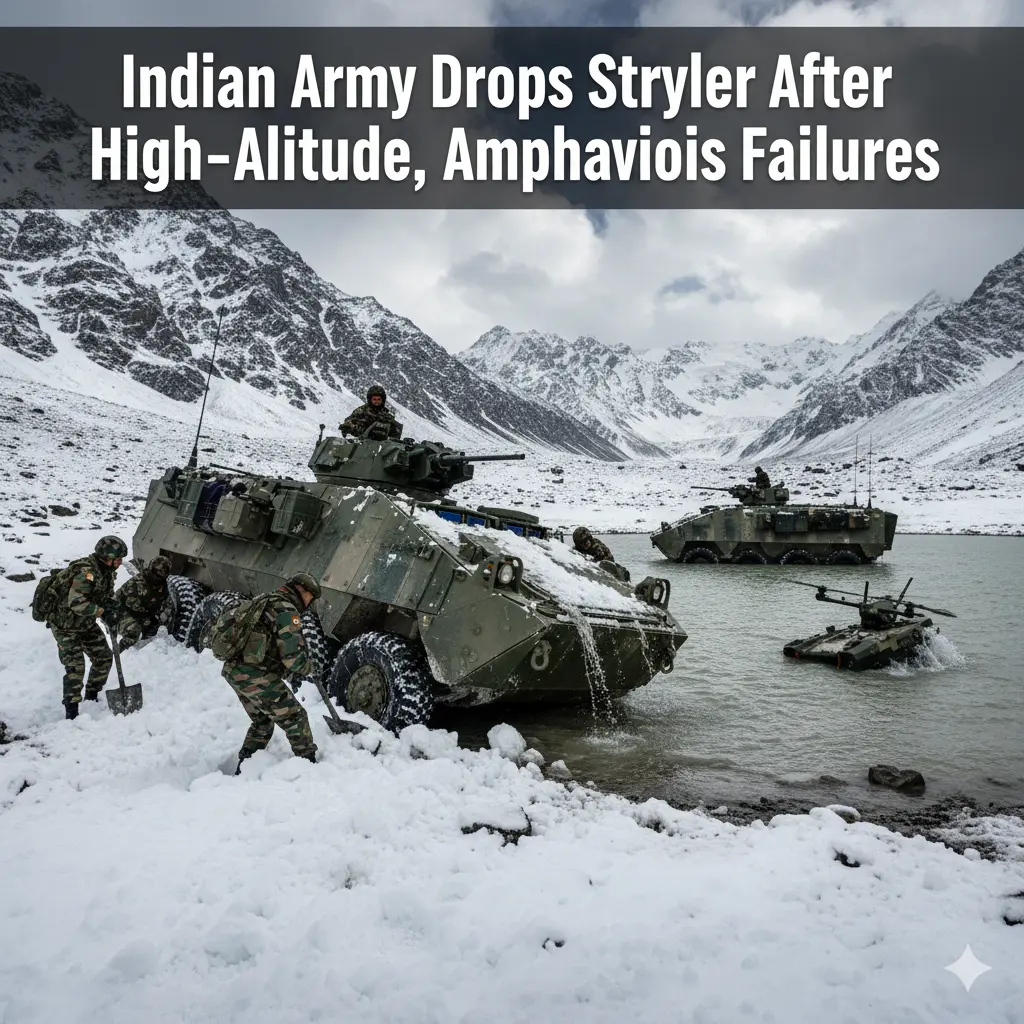
The passion of the Indian Army towards the US-produced Stryker armoured vehicles has been enormously dropping after unsatisfying results in amphibibious and high altitude missions. Originally intended to be a multi-purpose infantry fighting vehicle (IFV) to bring the modernization of the mechanized troops, the ongoing trial of the Stryker during Ladakh operations in the harsh unforgiving terrain and during the amphibious operations along the eastern seaboards proved to be fraught with failure. According to defence sources, the failures have made the Army shift to indigenous options such as Future Ready Combat Vehicle (FRCV), focusing on those platforms that are more appropriate to the varied indigenous operational problems.
Background of Stryker Trials.
In 2023, the Stryker family of eight-wheeled armoured combat vehicles manufactured by General Dynamics was detected on Indian Army radar as US-India defence relationships were enhancing as part of iCET postulates. It could travel 100 km/h, carried 30mm cannons or anti-tank missiles and was to be deployed to skirmish along the border. In 2024, joint trials began including high-altitude duties of the 14,000 feet and above above Ladakh, which is vital post-Galwan, and amphibious assaults representing an imitation of Brahmaputra river crossings.
Nevertheless, the evaluation reports indicate engine overheating, poor movement on steep slopes, and hydraulic failures in below zero temperature. The buoyancy of the vehicle in the amphibious trials at Arunachal outposts failed to help in high speed currents, thereby restricting the amount of cargo and leaving the vehicle vulnerable to the problem of underwater propulsion.
High-Altitude Shortcomings
The high altitude and rugged roads of Ladakh were the bane of Stryker. The 8×8 designed to suit the flat European battlefields had a problem in delivering the torques at some heights where the deficiency of oxygen inhibits the operations of the diesel engines. The trials recorded a loss of 40 percent power at over 15,000 feet, and that resulted in frequent stalling when trying to climb a hill imitating LAC patrols. Crew survivability issues were a lack of both NBC protection against chemical weapons and blast resistance in comparison to T-72 upgrades.
According to defence analysts, the weight of the Stryker (19 tonnes) further contributed to fuel inefficiency and the range decreased by 30 percent during cold start. A retired colonel noted that it failed to perform well with the wheeled AFVs of DRDO created to work in the extremes of Siachen.
Amphibious Role Failures
The amphibious tests revealed the design incompatibilities to the river warfare requirements of India. Stryker versions were capable of cruising basic water fording, but in 2-meter depths simulations in the Brahmaputra, all of them sank asymmetrically, and the bow thrusters could not withstand the wave action. The unification with Indian pontoon bridges was not compatible, and it caused a setback in the schedules of assaults. Moist conditions in the northeast also corroded electronics, a warning about Andaman deployments.
| Parameters Strategy | Stryker Performance | Indian Army Requirement | Gap |
| Highest Altitude Maximum Speed | 25 km/h (stalled) | 40 km/h sustained | Critical |
| Amphibious Depth | 1.8m (unstable) | 3m and 10 troops | Major |
| Engine Reliability | 65% uptime | 95% in the extremes | Severe |
| Unit cost | 5-7M | 4M indigenous | High |
This example highlights the reason why such solutions as Tata-IAV Wheeled AFV found their adherents.
Strategic Change and Implicates.
In 2025, post-trial debriefs by Army HQ gave Stryker imports a low priority due to incompatibility with Russian legacy fleets and high logistics prices. The Future Infantry Combat Vehicle project, which cost 2 billion dollars, currently favours Kalyani Strategic Systems and L&T products, taking lessons on Stryker traps, such as hybrid propulsion, modular armour, and indigenous engines.
Make-in-India is favored by budget constraints, where defence disbursement on capex is 70% of total. ToT poses challenges in US companies and China border acuity is forcing established high-altitude shooters such as K9 Vajra versions.
Future Procurement Outlook
The dying signals the Indian demands in the future: multirole cars that are capable of desert, mountain and jungles. FRCV RFPs focus on 50km /h cross country speeds and amphibious operations. The pullout increases local research and development of Stryker product which may be licensed to QUAD partners.
According to Army Chief Gen Upendra Dwivedi, Self-reliance beats off-shelf buys. This practical maneuver enhances the armoured advantage of India in changing threats.