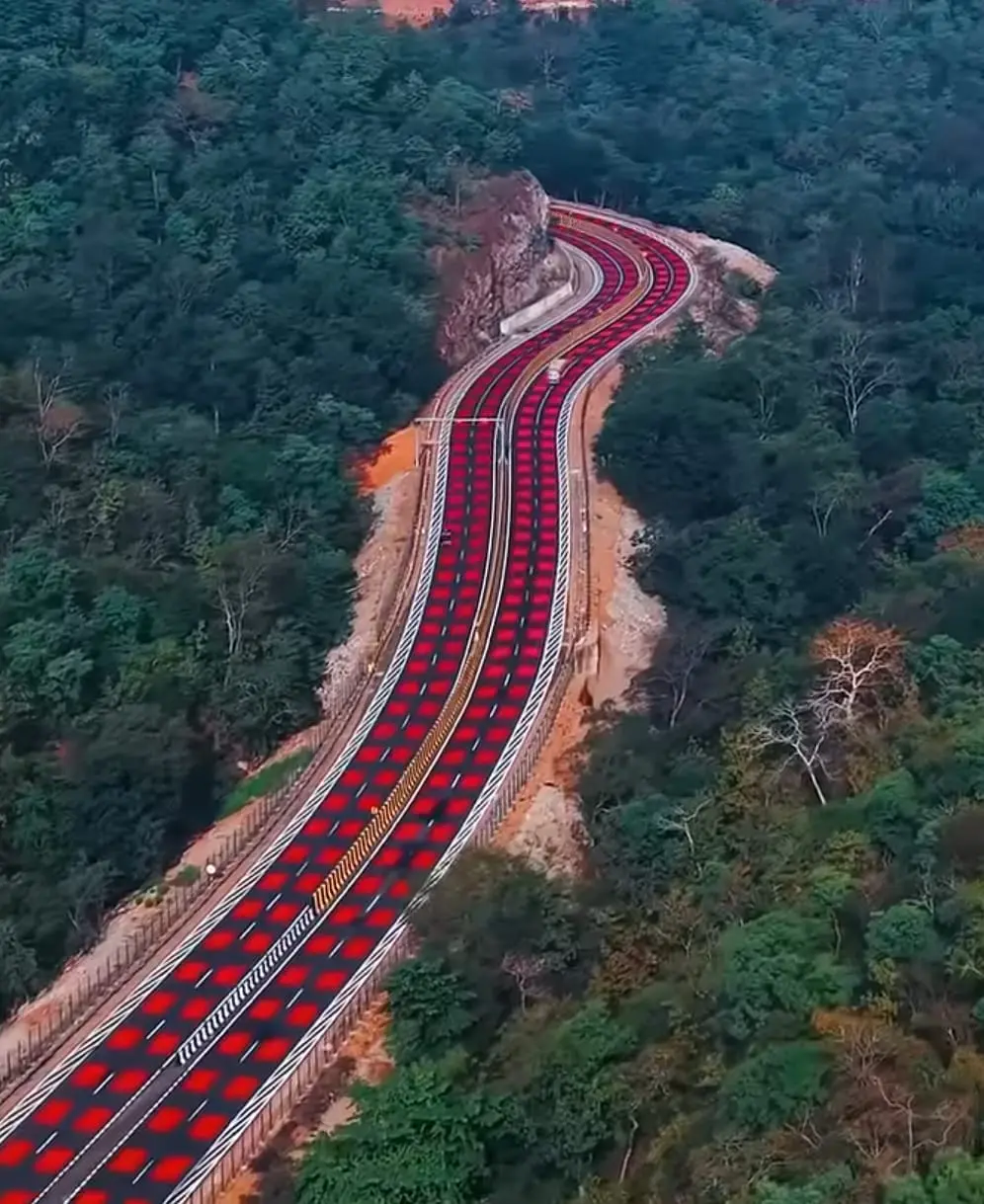
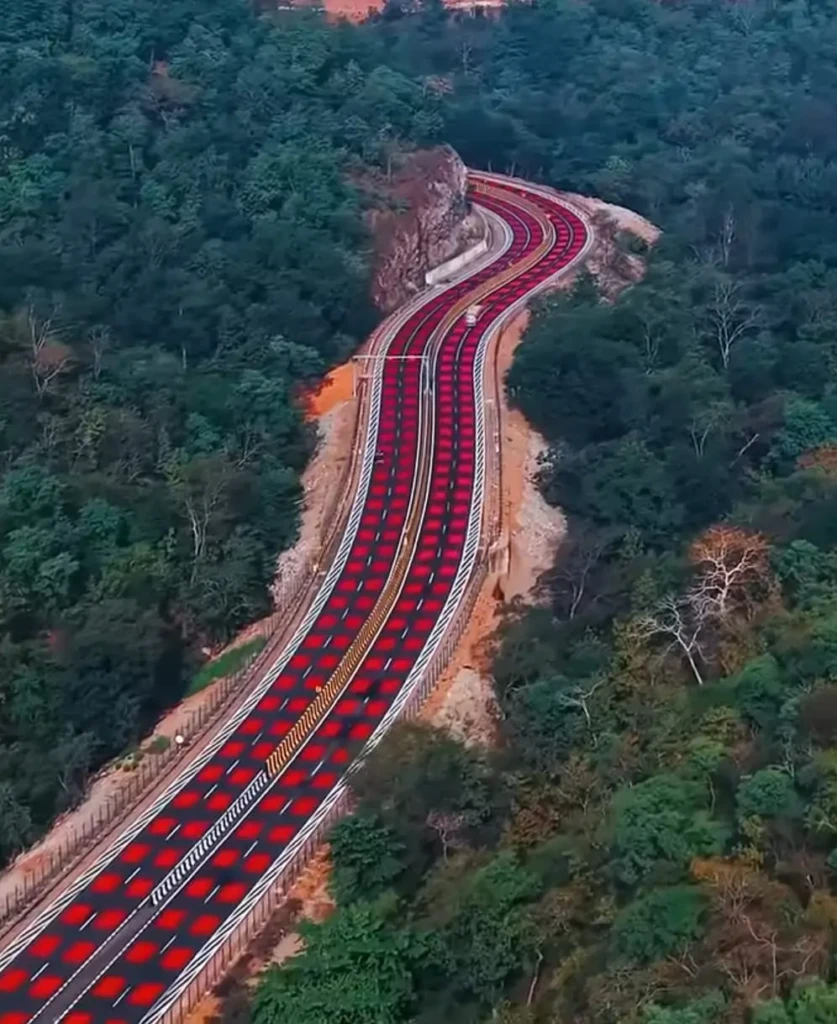
India The central state of Madhya Pradesh has been one of the first state to institute a ground breaking strategy to preserve wildlife conservation, by initiating the use of the first national red table top markings of roads in the forest highways. The innovation, launched in December 2025, on a highly sensitive section of the National Highway 45 (NH-45) between the cities of Bhopal and Jabalpur on a forest cover that is both ecologically significant (previously referred to as Nauradehi Sanctuary) is traversed. The four-lane expansion project is a 11.9 kilometer project costing 122 crore which incorporates these bold red strips not only as aesthetic flourishes but as life savings visual displays to drivers who must slow down and avoid crashing with the deer, the sambar, the jackals, the hyenas, and the growing tiger population in the reserve.
Background of the Red Road Initiative.
Highways cutting through conserved forest areas have always been a curse to the animals in India, and the state of Madhya Pradesh alone records dozens of roadkill cases annually. The 1,197-square-kilometer sanctuary in the 60 km of Jabalpur is perforated by the NH-45 which is the route of 4,000-5,000 vehicles daily with trucks and tourist buses. Animals that move in search of water, foraging or territory are often destroyed speedily, particularly at night time when visibility is limited. Conventional solutions such as signboards and speed breakers were not enough- signs are disregarded and the breakers hit cars and shocked animals with sound. In response to this the National Highways Authority of India (NHAI) looked to the world playbooks and put in place 5 mm thick thermoplastic tabletop red markings on a 2-km high-risk area. The project is also completed within a short time without causing significant disturbances with 25 strategically located underpasses depending on the patterns of animals movement, chain-link fencing, white shoulder lines and speed detectors.
Mechanics of the Visual Safeguard
Picture cruising at 80-100 km/h when the black asphalt erupts into sweeping, vivid red bands—3-4 meters wide, repeating rhythmically across both lanes. This “tabletop” design, slightly raised for tactile feedback, mimics a rumble strip while the crimson hue screams danger, triggering instinctive braking. Unlike jarring physical humps that scare animals into panic, these markings create a psychological barrier: drivers subconsciously decelerate by 20-30 km/h upon spotting the anomaly, maintaining a uniform slow zone over kilometers. Reflective properties ensure 200-meter nighttime visibility, amplified by solar blinkers. Early driver testimonials praise the non-abrupt slowdown, likening it to entering a “red alert” corridor that recalibrates habits without frustration. Wildlife benefits too—underpasses now function optimally as traffic crawls overhead, allowing safe subterranean passage.
Pilots of the Visual Guard.
Imagine driving at 80-100 km/h as the black asphalt bursts to sweeping, bright red surfaces- 3-4 meters wide and shall be repeated with a rhythmic repetition in either lanes. This tabletop-shaped design, tilted a notch higher so as to create some form of tactile response, looks a little like a rumble strip, whereas the crimson color is an indication of danger causing automatic braking. The markings form a psychological wall, unlike jarring physical humps that will scare animals into a panic, the marking makes drivers subconsciously decrease their velocity by 20-30 km/h when they can see the oddity and have a consistent slow zone that is kilometers long. The reflective property guarantees 200 meters night visibility that is enhanced by solar blinkers. Initial driver reviews compliment the gradual deceleration saying that it is like stepping into a red alert zone that reinstills the habits without annoyance. Wildlife is also a gain of this–underpasses should now serve the purpose they were originally intended to do, to pass safely underneath the traffic.
Mobilization and Formative Effects.
The forest officials and drone patrols note positive data only weeks after the launch: the average speed in the marked area decreased by 25 percent, and no cases of animal deaths were registered there in comparison to the historical data of 10-15 deaths per year. The speed cameras provide real-time information to NHAI dashboards and offenders are fined 1000. The local communities with 50 trained spotters in the nearby villages are able to pass sighting information through helplines making the process more responsive. There was a recent tragedy of cheetah cubs on a highway in Gwalor, which highlighted the urgency, making the model of MP timely. It is billed by experts of the Wildlife Institute as scalable engineering, which is a fraction of the cost of elevated corridors but returns high payoffs.
Expanding to the State of Madhya Pradesh and Beyond.
The state called Madhya Pradesh, the capital of tigers in India with 526 big cats, is under acute threat along the 5000km long forest-beta highways such as the NH-44 along Pench and Kanha. By mid-2026, plans aim to reach similar marks on 50 km with the implementation of AI predictive warnings, which are connected to vehicle GPS. Strays are prevented using complementary fencing expansions and eco-fencing pilots. National Nationally, this motivates implementations in Karnataka state Bandipur, Assams Kaziranga and Uttarakhand Corbett where roadkills take 500+ animals annually. With a 20 percent increase in human-wildlife interactions through habitat fragmentation, the red tabletops represent the concept of compassionate infrastructure the economic development through roads with the requirements of biodiversity stipulated by the Green Highways Policy.
Obstacles of the Future and the Vision of Conservation
Monsoons can wear off the thermoplastic, and hence the need to take the,annual, maintenance, of 50 lakh/lengthy vehicle, in upholding the culture and heavy trucking demand. The public awareness programs through FM radio, applications, and through the toll plazas teach the concept of red means wildlife, making adherence to eco-tourism benefits. With climate pressure reducing the habitats, this cheap solution ( 2-3 crore to fix 10 km) is farsighted. Madhya Pradesh Chief Wildlife Warden intends to have 500km coverage by 2027 at 500cr funding, reducing deaths by half. The red ribbon that Nauradehi is wearing is not just paint, it is a lifeline and it has been tied to the rhythm of nature sewing human progress through the generations to come.