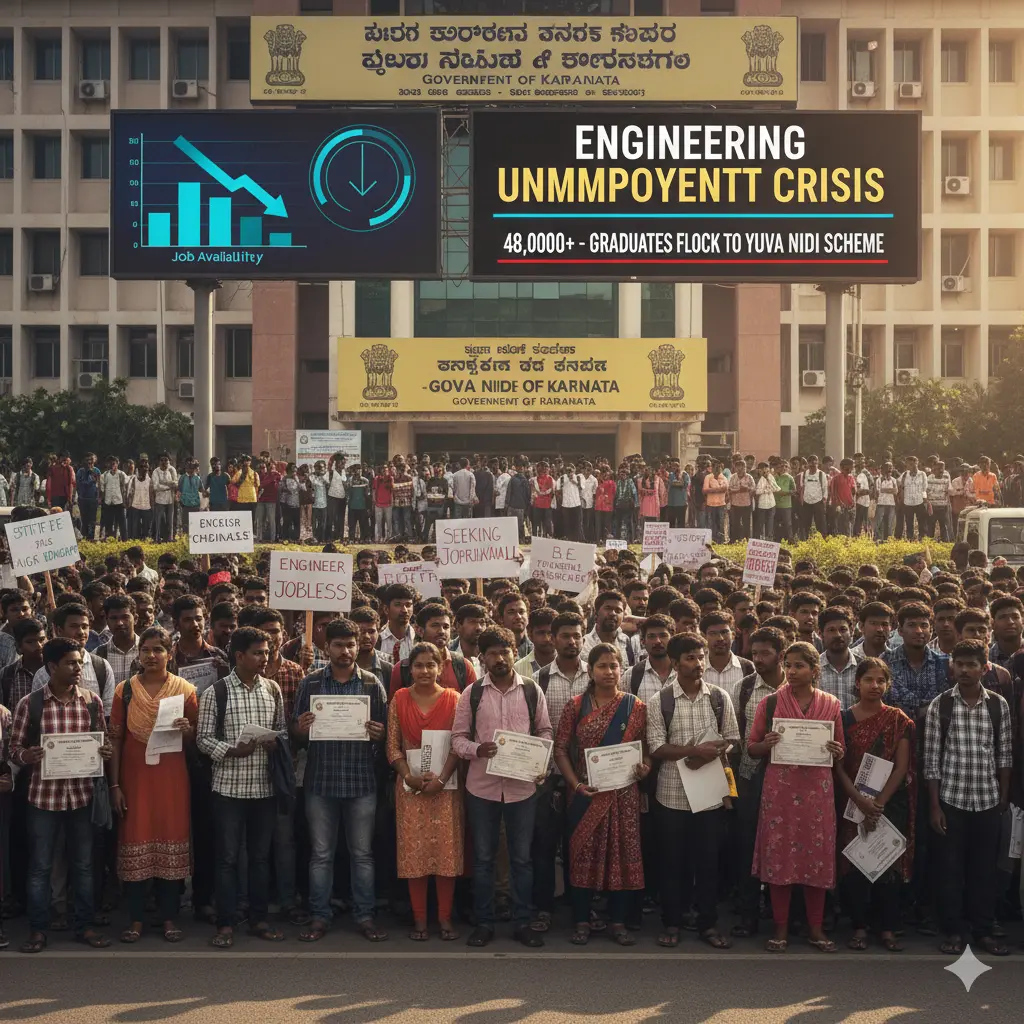
A bleak truth has been revealed by Karnataka Yuva Nidhi Scheme, which offers unemployment benefits to fresh engineering graduates: of an estimated 48,000 graduates (13 percent of all registered) in the country, about 13 percent are unemployed six months after graduation, a systemic skills failure in the pipeline of Indian technical education. Out of 3.79 lakh total registered in January 8, 2026, 2.98 lakh were eligible to receive a 3000 per-month stipend with 47,000+ engineers tops in the list and 3 lakh non-engineering counterparts. The flagship promise of the Congress government is struggling with poor training adoption, which is creating doubts on the employability of youth considering that 1 lakh engineers are being produced in the state every year.
Shocking Scale of Joblessness among Graduates.
Distress engineering prevails: 43,529 BE/BTech graduates, 374 MTechs, 4,250 diploma graduates are registered against 3 lakh arts/science/commerce graduates. The annual result of 1 lakh qualifiers is only 20,000-25,000 engineers are getting jobs and 75 per cent are being unemployed, which Skill Minister Dr. Sharan Prakash Patil blames on hands-on skills deficiencies.
Yuva Nidhi mechanics: Graduates/ diploma holders (2022-23/2023-24 batches), Karnataka-domiciled, unemployed 6+ months will receive 3000 (graduates)/1500 (diplomas) in 2 years, through DBT. 250 crore will be allocated, applications on Seva Sindhu portal.
| Category | registrations | Eligible | Monthly Aid |
| Engineering Graduates | 43,529 | 38,000+ | ₹3,000 |
| Engineering Postgrads | 374 | 300+ | ₹3,000 |
| Engineering Diplomas | 4,250 | 3,500+ | ₹1,500 |
| Non-Engineering Graduates | 3,00,214 | 2,50,000+ | ₹3,000 |
Training Rejection: The Greater Diversion.
Free skill programs through CEDOK, GTTC, KGTTI, called Yuva Nidhi Plus, have 90 per cent no-shows although ₹27 crore is allocated to it under 2025 without being used. Young people are afraid of dole being discontinued; Minister Patil explains: Stipend till placement + 2 years. Outreach through SMS/calls are ineffective; 2026 can be twice through shared funds.
Bajaj-PES model: Patil presents an example of company-paid campus training (the government reimburses), and his idea is to copy it, pointing out that 1 lakh engineers a year suffice, but the skill set they have does not fit the job market.
Systemic Failures Exposed
Curriculum outdated: VTU curriculum is out of date Industry 4.0 – AI/ML, cybersecurity, EV design. 80% colleges AICTE-weak infrastructure; placement cells focus on mass recruiting, not start-ups. Studies show a decline in labour force that occurs after the scheme.
National parallels: India has 15 lakh engineers every year; NASSCOM has 70 percent not employed. Karnataka is a reflection: Tier-2/3 colleges spit out graduates with no coding, no communication, no aptitude.
Government Reaction and Industry Backlash.
Multi-level skill centres intended; Yuva Nidhi 2.0 is obligatory to go through training. Patil: “Misapprehension of dole loss continues- 27 crore of loss depicts attitude problem.
Corporate criticism NASSCOM requires NEP-compliant curriculum, apprenticeship changes. FICCI cautions that Doles postpone the acquisition of skills. Defense by engineers: 3,000 hardly reimburses the cost of PG; training is low-quality.
Political crossfire: BJP strikes against Congress: ” 250 crore populism sop; investment in skills required. Congress answers back: “Earlier govt had neglected youth-48k engineers show crisis not our fault.
Long-Term Implications
Demographic dividend risk: the high rate of unemployment among the youth in Karnataka (40 percent) is a threat to start up capital (Bengaluru produces 40 percent of the national). Brain drain is hastened-US H1B visas skyrocket 25.
Solutions roadmap:
- Overhaul of curriculum: AICTE requires 50 percent practical credits.
- Academia-industry centres 100 colleges have company centres.
- Apprenticeship requirement: 6 months binding after graduation.
- International certification: AWS, Cisco alliances.
When the number of engineers is 48,000 it represents a more fundamental vice, which is quantity rather than quality in higher education. Yuva Nidhi does not save time, and unless there is skills revolution, the tech dream of Karnataka stops. Young people will have to shift away to drills.