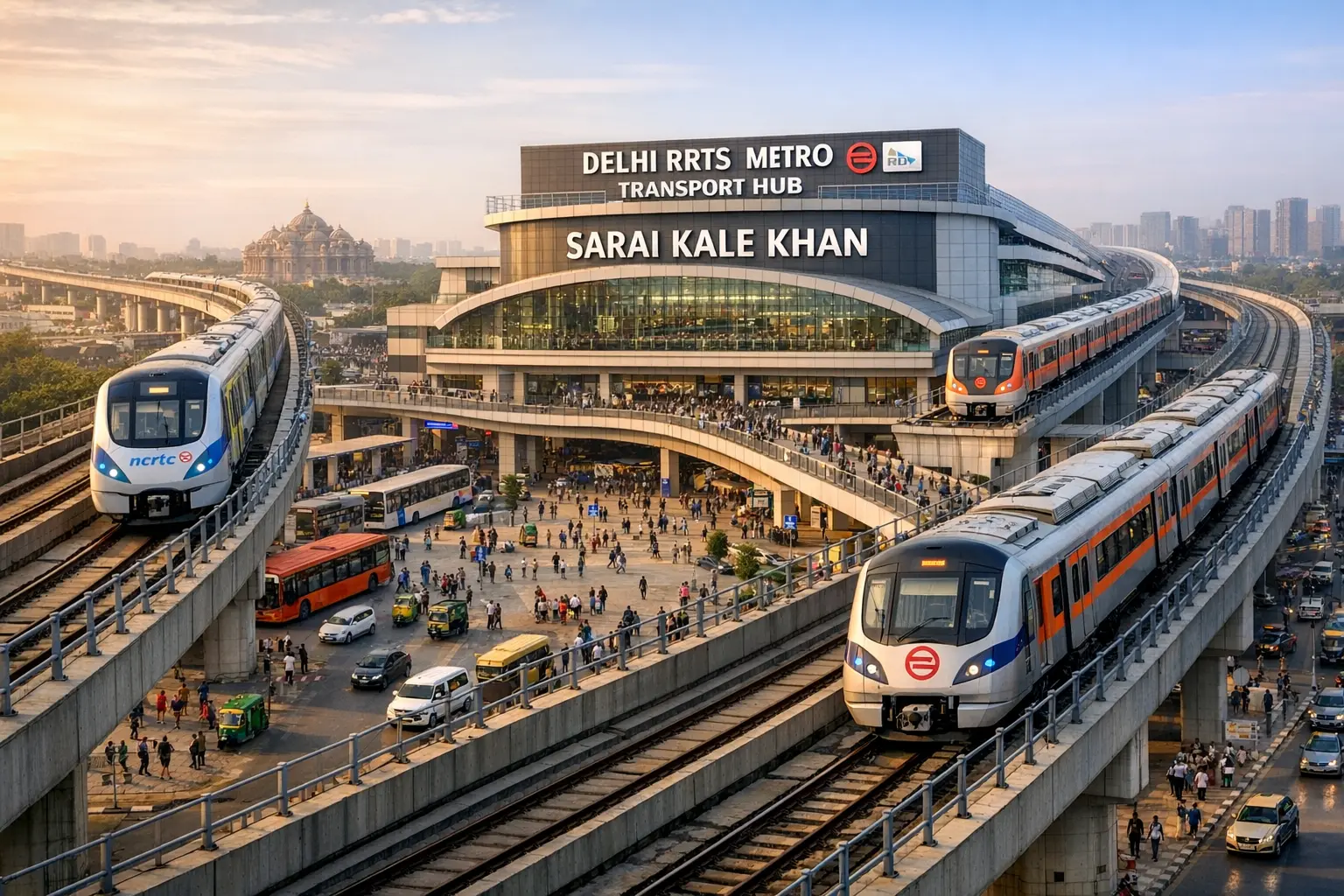
The Sarai Kale Khan has turned out to be the highest multimodal transport center in Delhi with the full completion of the Delhi-Meerut RRTS corridor, with the facility of the addition of the Namo Bharat trains that can integrate with the Delhi Metro, rail, and buses. The final 5-km (between Sarai Kale Khan and New Ashok Nagar), 21-km (between Meerut and Modipuram), nbconnected on February 22, 2026, by prime minister Narendra Modi, shrunk the distance between Delhi and Meerut to a little under an hour. This crossing also renders this station the busiest in the capital as compared to the international ones as well as clearing the congestion in NCR.
RRTS/ Metro Integration Boost.
The first regional rapid transit system in India is the Namo Bharat RRTS that currently links easily at Sarai Kale Khan with the Pink Line of the Delhi Metro, Hazrat Nizamuddin railway station and Veer Hakikat Rai ISBT. It has a 280-meter foot overbridge (FOB) with six travelators (nearly complete and will be opened in March 2026) and hustle free transfers. At NCRTC, interoperability is given a priority: there are four tracks and six platforms where one can ride a train without having to change the trains to travel between the lines.
Union Minister Manohar Lal Khattar highlighted the Delhi metro-plus-RRTS was the largest in the world implying it provides high speed of 55 minutes Delhi-Meerut travel as compared to three hours traveling through roads. Chief Minister, Rekha Gupta praised it as an economic boost, an employment source and reduced pollution by taking up public transportation.
Hub Features and Connections Hub Features and Connections This is the chapter that gives a detailed discussion about hub features and connectivity.
It possesses the best facilities in the world: a 275-car and a 900-two-wheeler parking space, an exchange of 15 buses in the city under the elevated station, and drop-offs. The last-mile connections are enhanced by the availability by the Ring Road. Because Phase-1 corridors meet here, it preconditions additional extensions in the future: Delhi-Panipat-Karnal (125-130 km, 1-hour in transit), Delhi-Gurugram-SNB-Alwar, and Delhi-Neemrana-Bawal routes which are waiting to get the approval of the Cabinet.
| Feature | Details |
| RRTS Lines | Delhi-Meerut, Panipat-Karnal, SNB-Alwar, Neemrana-Bawal (planned). |
| Metro connection | Direct connection with pink line |
| Rail Integration | Hazrat Nizamuddin by FOB with travelators |
| Bus Station | Veer Hakikat Rai ISBT + 15-bus bay |
| Parking Capacity | 275 cars, 900 bikes |
| Travelator FOB | 280m, 6, commencing March 2026 |
This kind of arrangement will limit the privateness of vehicles wherein multimodal effectiveness is pursued.
Critical and Economic Impact.
The hub transforms the commuter lifestyle in Delhi-NCR that can be defined to have population pressure as the cause of traffic misery. RRTS reaches a speed of up to 160 km/h which makes the possibility of having regional sprawl and spur real estate and balanced development possible. Authorities estimate that millions of commuters per day can benefit through smooth transitions – RRTS in the case of regional transfers, metro in the case of city transfers, trains in the case of long-haul and buses in the case of locals.
The NCRTC design philosophy lays significant emphasis on integration with metros, expressways, and airport and this forms a model of the whole-of-region mobility. The best use of space in the city density is the high-rise building by Sarai Kale Khan.
Challenges and Future Plans
In its early days, the station had experienced slowdown, and the initial opening of June 2025 was delayed due to integration problems, but the latter have been successful. The last stages like FOB and bus bays still remain slow. Expansion will make it serve 3 new corridors, and this will lessen the traffic of Delhi, as it will be linked to Haryana and Rajasthan through high-speed connections.
Meerut Metro will be added to the local loops in Delhi-Meerut RRTS which is fully operational (82 km). This hub can be seen as an instance of infra push by India, which is speed, sustainability, and smoothness combined.
Khattar explains that Sarai Kale Khan will also be among the busiest stations, and will be driving the transport revolution at NCR. Employees gain; metropolis, clean air and transport.