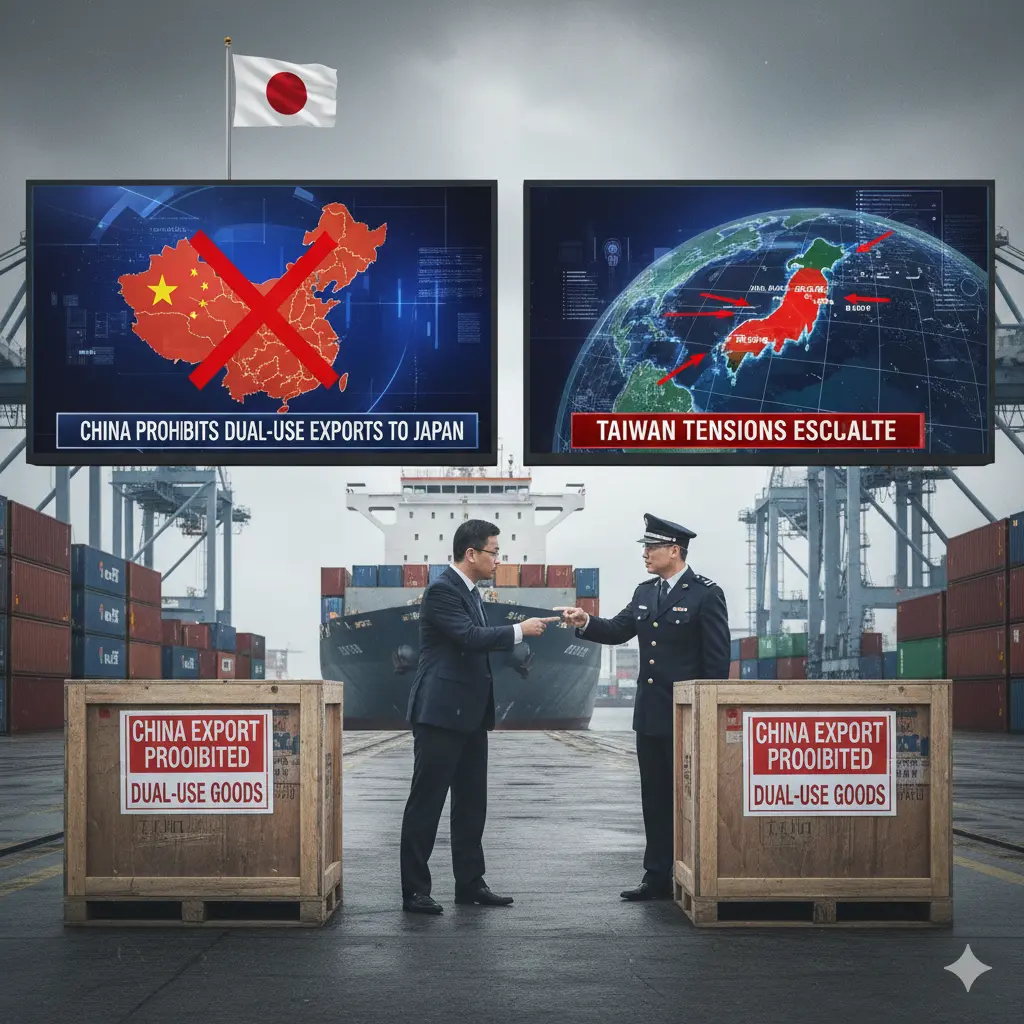
China has also imposed an immediate export ban on dual-use items; goods with both civilian and military uses over Japan; and is targeting the defense strength of Tokyo since the situation in Taiwan is becoming hot. The commerce ministry announced the drastic restrictions on January 6, 2026, including the ban on drones, navigation systems, guided weaponry components, surveillance technology, and high-performance computing that will be sold to military users of Japan or any end-use that increases its lethality. Breachers are prosecuted across the world and this is the second-toughest trade weapon precipitated by Beijing.
Stimulus: PM Takaichi Taiwan Warning.
The step is a retaliation to comments made by Prime Minister Sanae Takaichi in November 2025 into parliament, when she stated that a Chinese invasion of Taiwan would be a survival threat, and would be sufficiently serious to provoke Japanese military intervention. This is perceived by Beijing as going against the One China principle, after Japan doubled her arms budget and PLA jets locked the radar of the JASDF fighters. Previous salvos entailed halting of the imports of seafood in China and travel warnings to Japan.
Japanese Foreign Ministry protested strongly claiming that the Japan-only ban is a reflection of the international norm deviation. During the negotiations with the Chinese deputy consul, Shi Yong, Asia-Oceania chief, Masaaki Kanai insisted on retracting them.
Economic and Strategic Impact.
Dual-use area includes semiconductors, optics and AI chipsets-China is already providing a quarter of Japanese sophisticated parts. The rearmament of Tokyo (now 10 trillion, that is 2% GDP) is now met with supply shocks, which postponed the upgrades of F-15 and Type-12 missiles. Japanese companies such as Mitsubishi Heavy industries are scrambling after these Korean/Taiwanese alternatives at the risk of 15 percent price increases.
| Affected Goods | Military Impact | Japanese Counter |
| Drones/Surveillance | ISR gaps | Accelerate Switch-50 |
| Navigation/Guidance | Accuracy of missiles | Domestic quartz tech |
| Computing/Semicon | Radar/AI delay | TSMC alliances |
| Weapons/Components Optics | Stealth Coatings | QUAD supply chains |
The Xi Jinping of China also appealed to the history of WWII in an attempt to persuade Seoul to join the fight against Japanese revivalism. Tokyo is looking to WTO challenge but opts to diversify.
Broader Escalation Pattern
This caps 2025’s tit-for-tat:
- Japan imposes 18 Chinese companies with the violation of the sanctions against Russia.
- China reinstates seafood ban in Fukushima.
- Taiwan is surrounded by PLA exercises after Takiichi commentaries.
- ECDs on the JASDF over East China Sea.
Such rotation of Japan as Fukushima wastewater resistance, AUKUS technology sharing, is generating economic coercion by Beijing. Analysts project supply chain bifurcation: Japan is quickening Chinas plus one to Vietnam/India.
Regional Realignment Risks
South Korea is also observing with one eye, and balancing on the one hand, alliances with US, and on the other hand, lost exports. Taiwan strengthens Japan investments in chips; QUAD strengthens defense technological alliances. Beijing threatens more actions in case Tokyo continues.
The prohibition is a test of Article 21 of China-Japan peace treaty, and Tokyo is taking a stand: “Security beats trade dependencies. Northeast Asian delicate détente is tearing as twin uses flows are cut off- Taiwan strait is hotspot.