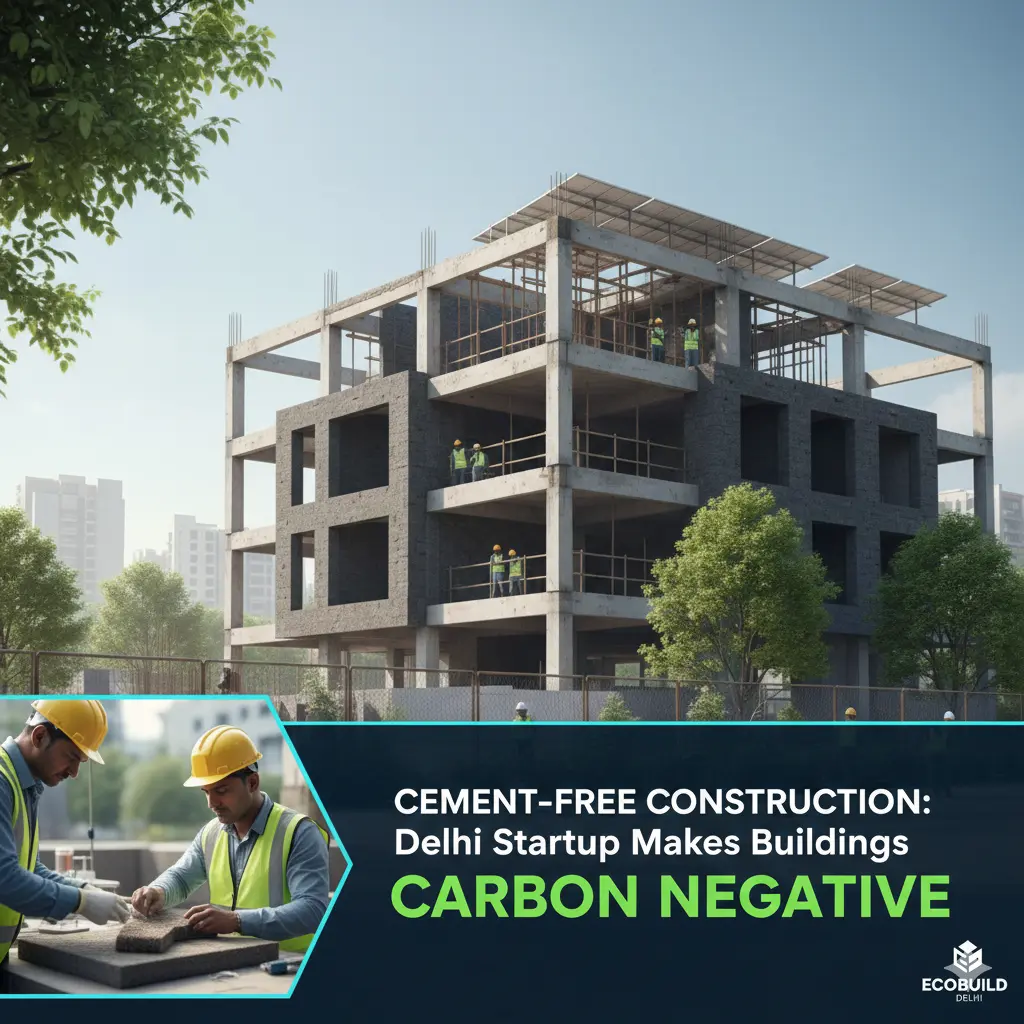
One Delhi-based company, Vishwa Hara Chakra, has sparked a green revolution in the Indian construction sector by fully abolishing cement, one of the biggest pollutants of the world, and producing materials of carbon-negative buildings out of industrial waste. The company, which was founded by educationist Megha Rathee and Professor Ashwin Gopinath in 2024, recycles fly ash, slag, and construction debris to make Eco-Concrete bricks, pavers, and insulation that are better than traditional cement but reduce CO 2 emissions by 80. Their technology is patented and already used on projects with Tata, Adani, NBCC and Border roads organisation in severe climatic conditions of Kargil to Noida Airport.
The Cement Crisis: the Carbon time bomb in India.
The construction industry of India consumes 500 million tonnes of cement each year and that releases 400 million tonnes of CO 2 and that represents 8 percent of the national CO 2 emissions and 10 percent of the world. Only the consumption of clay bricks takes 750 billion units annually, consuming the top soil and emitting pollutants. The conventional Portland cement takes 1,450 C kilns with 800 kg CO 2 per tonne emission. The solution of Vishwa Hara Chakra? Zero-cement Eco-Concrete with ambient-temperature chemical binders, which capture carbon during curing.
Breakthrough metrics:
| Total parameter | Traditional Cement | Eco-Concrete |
| CO 2 Emission/kg | 800g | -200g (Carbon Negative) |
| Production Heat | 1,450°C | 0°C (Ambient) |
| Waste Generation | 10-15% | <1% |
| Compressive Strength | 40-50 Mpa | 60 + Mpa |
| Cost/km² Built-up | ₹2,500 | ₹1,800 |
Green Concrete: Waste to Wonder Cement.
The proprietary binder fuses of Vishwa Hara Chakra combine fly ash (60%), ground slag (25%), special activators (10%), and aggregates (5%) with greater strength in comparison to bricks made of clay-fired. None of the kilns, limestone mining, no clinker, production is the source of negative emissions through carbon sequestration.
Product portfolio:
- Eco-Bricks/Pavers: 30 lighter, water free curing.
- Zephyr Insulation: Fly ash-aerogel panels (8 resistance vs 4 of thermocol)
- Waste-to-CNG: It transforms construction/agricultural waste into bio-compressed natural gas.
Tested in Rohtang Pass (-25 o C) and in Kargil (4,500m above sea level), the materials are tested to extreme thermal cycling.
Traction: Startup to Infrastructure Backbone.
Revenue target: 5 crore by August 2024 (bootstrapped 25 lakh + family capital). Scalability was confirmed with Flagship 1.8 crore Tata order to Noida international airport.
Blue-chip clients:
- Airport runways, terminals, Tata Projects.
- Adani Group: Data centre underpinnings.
- NBCC (India): Retrofitting of buildings by the government.
- BRO: the border roads at high altitude.
- ITDC/MES: Hotels/infrastructures.
NBCC alliance is the indication of mass adoption; 2026 target: 10% market share in Delhi-NCR.
Making a Nationwide Jump to Carbon-Negative Construction.
Three-pillar expansion:
- Zephyr Insulation: Hunter-Jaisalmer extreme weather.
- Circular Economy: 100 recycling plants of construction waste.
- Waste-to-Energy: 50 bio-CNG plants of MSW/agri.
Policy windfalls: Congruent with 1 lakh crore PLI scheme (cement alternatives), Green Building Norms, and Swachh Bharat waste objectives. Startup plans 100C revenue in FY27 through 20 plants.
Difficulties overcome, Industry changed.
First disbelief: Rathee remembers that large companies ignored us as another green startup. The breakthrough was through the mentorship of Lt Gen (Retd) J.S. Nain and Tata validation. Technical challenges -binder stability, scale-up were determined by 18 months R&D work in 50+ formulations.
Competitive moat: Patent chemistry, military level testing, zero heat processing crashes imports (geopolymer bricks, 3 times the price).
Construction Decarbonization Blueprint in India.
Vishwa Hara Chakra: Carbon-negative construction is no longer a fantasy: It is already implementable. 80% reduction in emissions has. By scaling to 10 percent, the market sequesters 40 million tonnes CO 2 per annum, which is supposed to be 200 million trees.
Megha Rathee vision: Cement-free India: A carbon-negative nation. We have broken the formula–now we grow–bigger. Vishwa Hara Chakra is redefining the construction of a hotter planet, which includes Delhi laboratories, Himalayan posts, and the like.