The Union Budget 2026-27 emphasises regionally differentiated strategy to accelerate diversification into high-value crops across India’s coastal, North Eastern, and Himalayan regions. As per Food and Agriculture Organization Corporate Statistical Database (FAOSTAT) 2024, India ranks second in the world in coconut production. Over the past decade, the agricultural sector in India has grown at 4.45 percent, the highest when compared to previous decades.
What are high value crops?
High value crops refer to horticulture produce such as fruits, vegetables, spices, flowers, and aromatic plants. They are referred to as high value crops because they generate significantly higher net returns per unit of land compared to traditional staple crops like cereals (wheat/rice) and pulses.
Horticulture as a Driver of Agricultural Growth in India
- Global position: India is the world’s largest producer of onions and shallots (dry excluding dehydrated) contributing close to 22.42 percent of global production and ranks second in vegetables, fruits, and potatoes.
- Economic nucleus: The horticulture sector accounts for approximately 37 percent of the Gross Value Output (GVO) within the agricultural crops sub-sector of Agriculture and Allied sectors.
- Productivity growth: the agricultural sector has performed well with the growth rate at 4.45%, the highest rate compared to traditional agriculture.
- Employment engine: these crops are labour-intensive, which generates employment opportunities in rural and tribal areas.
- Nutritional Security: HVCs provide essential vitamins and minerals, fuelling the agro-processing industry and improving national nutrition.
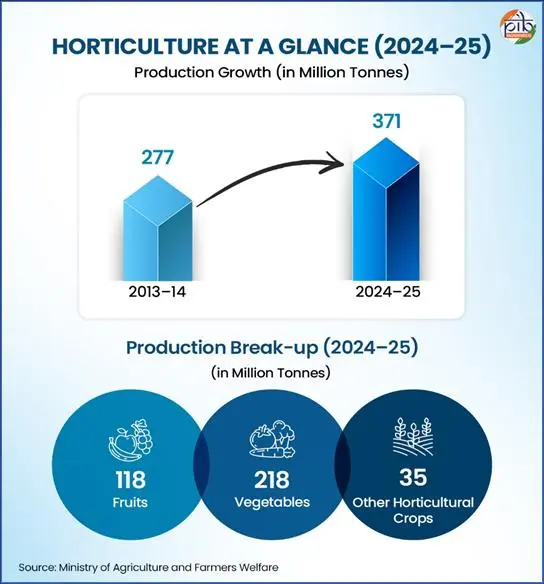
Regionally Anchored Strategies for High-Value Crop Development
- Coastal Region (Coconut, Cashew, Cocoa, Sandalwood): India ranks second with 22,44% of coconut production in the world, supporting 30 million people including 10 million farmers.
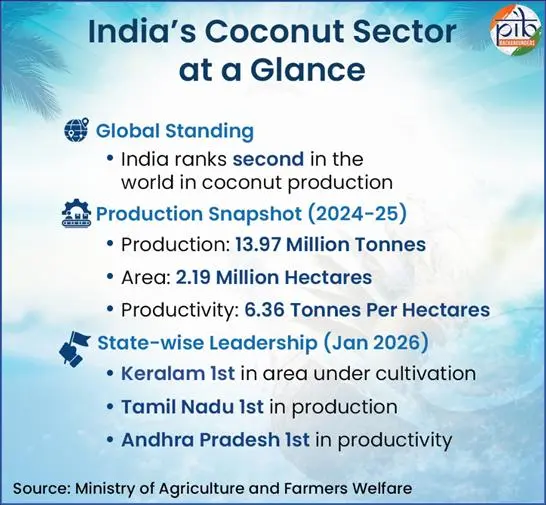
- Institutional support is given to through the Coconut Development Board — active across 22 states and UTs.
- Cashew: it was introduced in India in 16th century by the Portuguese. It thrives on degraded and wasteland soils.
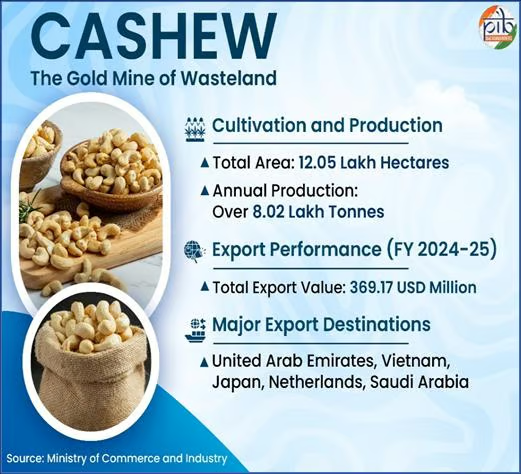
- Cultivation across States such as Odisha, Andhra Pradesh, Maharashtra, Tamil Nadu, Karnataka, Kerala West Bengal and parts of the North Eastern region.
- Cocoa: it is a commercial plantation crop cultivated for the seeds of its fruit, which are then processed through fermentation to produce flavoured cocoa powder. It is grown almost exclusively as an intercrop under coconut and arecanut utilising 40–50% sunlight penetration.
- The major cocoa-growing States are Andhra Pradesh, Keralam, Karnataka and Tamil Nadu.
- The budget targets Indian Cocoa as a premium global brand by 2030.
- Sandalwood: Santalum album, commonly known as Indian sandalwood or chandan, is a highly valuable and culturally significant tree species in India. It is widely used in religious practices and is globally renowned for its premium essential oil, which is extensively used in the perfumery and fragrance industries.
- Approximately 90% of India’s resources are concentrated in Karnataka and Tamil Nadu.
- Hilly Region & North Eastern Region (Agarwood, Walnuts, Almonds, Chilgoza)
- Agarwood: it holds particular economic and cultural significance as a premium aromatic resource. India hosts 150 million agarwood trees (as of January 2026) — 90% in Northeast, primarily Tripura and Assam.
- Tripura’s agarwood market alone carries a potential annual turnover of ₹2,000 crore.
- Internationally known as Oud: used in traditional medicine, religious practices, and luxury perfumery.
- Exports are regulated under the Convention on International Trade in Endangered Species of Wild Fauna and Flora (CITES), with limits set at 151,080 kg for agarwood chips and 7,050 kg for agarwood oil.
- Walnuts, Almonds, Chilgoza: India’s hilly regions cultivate several nut crops suited to cooler climates and specific agro-ecological conditions, including walnuts, almonds, and pine nuts. Walnut is the most significant temperate crop in the country. Jammu & Kashmir accounts for the majority of its cultivation, whereas Uttarakhand, Himachal Pradesh, Ladakh, Arunachal Pradesh, and Manipur make only a minimal contribution in comparison.
- Chilgoza (pine nuts): it is an important nut crop in the Himalayan region, also referred to as the “Champion of the Rocky Mountains,.”
- This crop is an important source of livelihood for tribal communities in the Kinnaur district of Himachal Pradesh.