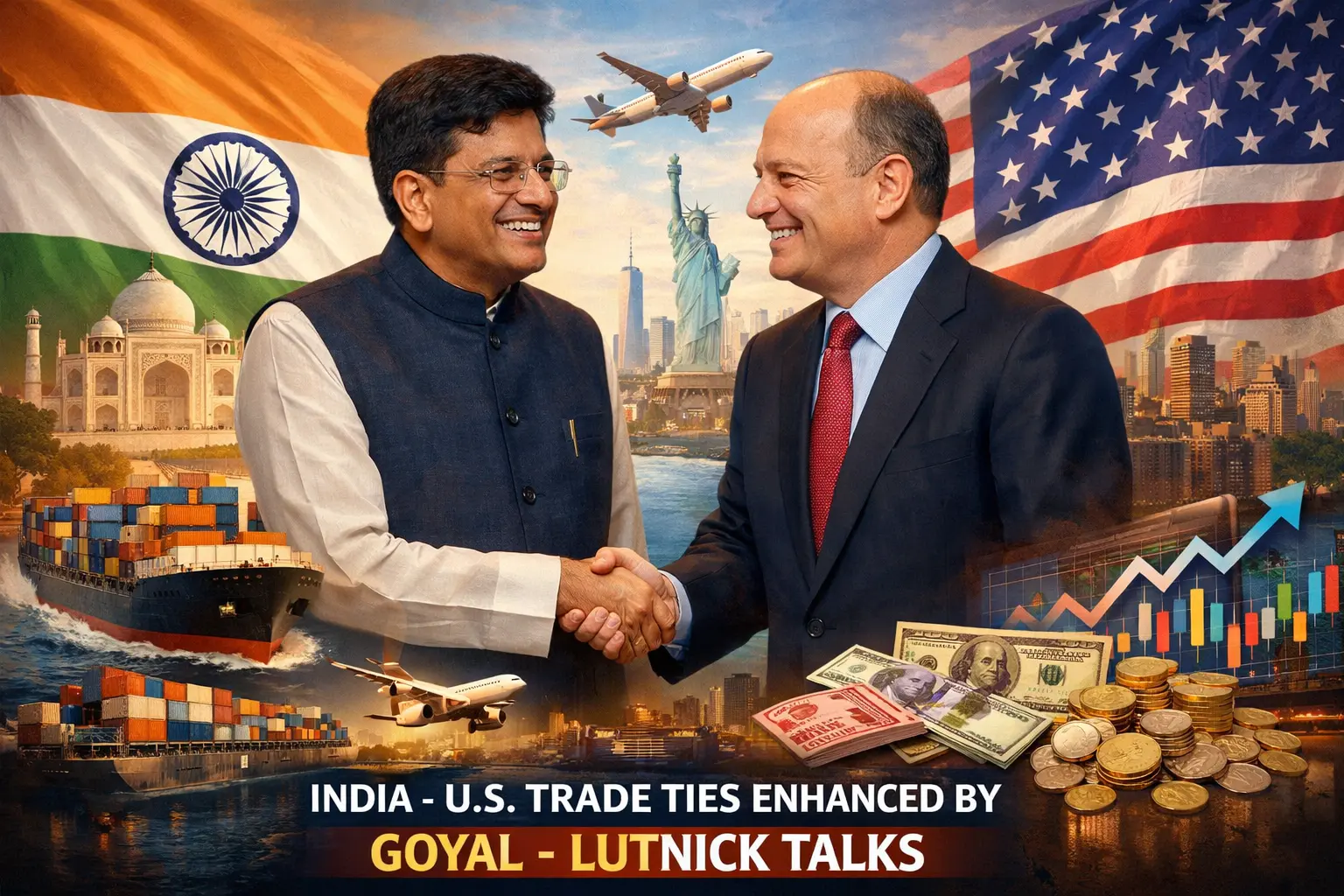
On February 25, 2026, the Commerce Minister of India, Piyush Goyal, had a fruitful meeting with US Commerce Secretary, Howard Lutnick as well as the US Ambassador, Sergio Gor, discussing a way to increase bilateral trade in the changing tariff environment. A meeting, held in New Delhi over lunch, marked a new push to a first-phase trade pact, after the US Supreme Court struck down President Trump in his blanket tariffs. Goyal defined the engagement as very fruitful that included the opportunities of economic partnership in terms of goods, services and investment.
Background of Renewed Negotiations.
The negotiations follow a US Supreme Court decision to invalidate Trump-imposed duties on reciprocated tariffs, which have been replaced with a 10% ceiling tariff on every nation over 150 days. This cleared Indian US trade agreement hitches brought about by protectionism. Lutnick is a Trump appointee who is a Cantor Fitzgerald CEO, who once forecasted that India would give in to tariff pressure; now, after the ruling on the matter, he had visited Delhi to push deals.
Previous agreements relaxed mutual responsibilities and reduced India huge trade surplus with the US through declining exports and increasing imports. When clarity ensued, Goyal observed resumption and this is in line with Phase 1 finalization projected to be achieved in April.
Key Discussion Areas
Discussions covered market access, digital trade, supply chain resilience and critical minerals. India wants relaxed US farm goods restrictions; America looks at defense, pharma IP and data flows. Semiconductors, green energy, and AI cooperation were created, based on iCET framework. Lutnick and “many areas were complimentary in their collaboration; Gor described it as a very productive lunch.
Goyal focused on win-win: Indian reforms such as PLI schemes match US reshoring. Trade goes bilaterally to 190 billion in FY25; aim is 500 billion by 2030.
| Focus Area | India Priorities | US Priorities |
| Goods Trade | Dairy, almonds access | Steel, auto parts easing |
| Services | IT, pharma exports | Data localization relax |
| Investment | Semis, EVs joint venture | Defense co-production |
| New Frontiers | Critical minerals, green | techIP enforcement |
Strategic Implications In the Trump 2.0.
The visit by Lutnick changes the position because the former was accusing PM Modi of unwillingness to work. As tariffs are watered down, leverage balances. The US markets are beneficial to India and the Chinese markets are not. After decision countries re-examine agreements; India establishes itself as dependable ally.
The appearance of ambassador Gor highlights the importance of Delhi. Meeting in terms of friend-shoring: flows can be exemplified by Apple Texas, Mac mini, plant in Gujarat, Micron.
Economic Interests and Results.
Currently, India has temporary 10 percent duties in its exports to US (textiles, gems, IT), yet deal offers zero-duty zones. Excess (30B+) services enhance resilience. Post-pact projected analysts growth is 15-20 trade.
The X post of Goyal with picture became viral, and increased sentiment. The visit that Lutnick makes to Delhi, after confirmation is an indication of rapid developments. Operationalization during April phase 1 would open doors to $10B +/annual gains.
Broader Bilateral Momentum
Negotiations are in line with Trump America First through just deals, but not walls. India’s WTO push complements. The intended India visit by VP Vance looks at an even higher level.
With Goyal as host, all was optimistic: “There was a lot of fruitful talk on how to further our trade and economic relationship. The words were positive echoed by Lutnick and Gor. This tryst places 2026 at the center of the $500B ambition, blending strategic trust and commerce.