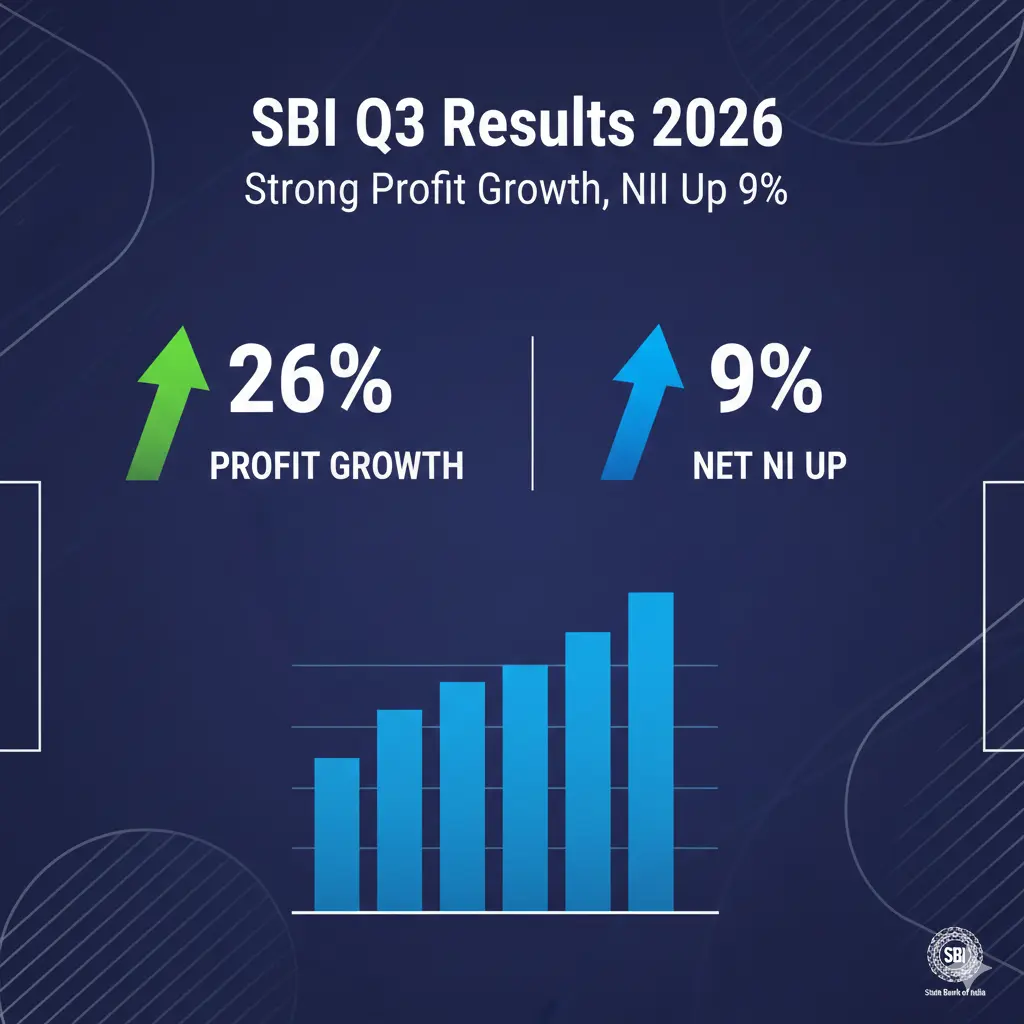
The State Bank of India (SBI) has reported blockbuster results for 3Q FY26, with a net profit of 21,028 crore, representing a strong year-on-year increase of 24 per cent from 16,891 crore. The net interest income (NII) increased by 9 to 45,190 crore to support the sustained growth in loans and controlled prices in the face of growing deposits.
Record Profits in a booming environment.
The standalone profit after tax (PAT) of SBI was the highest in the history of the bank, which outpaced analyst projections of 17,800 crore easily. The operating profit increased by 40 percent YoY to reach Rs 32,862 crore, which demonstrates both the operational leverage and cost-efficiencies. In the nine months to December 2025 (9MFY26), cumulative PAT reached up to Rs 60,348 crore, equivalent to 15.5 percent YoY.
The outperformance was attributed to the expansion of the balance sheet in terms of health by Chairman Challa Sreenivasulu Setty and the reduction of provisions. The total income increased by 10.6 percent to Rs 1,85,648 crore and interest income increased by 4.4 percent to Rs 1,22,556 crore QoQ.
NII Strength and Stability of Margin.
NII’s good development was core growth, which showed strong progress and mobilisation of deposits. Domestic NIM was steady at 3.12% (down 3 bps YoY, but up 3 bps QoQ), and the total NIM was 3%. Interest expenses increased 1.8 per cent year-on-year to Rs 77,366 crore, although the growth of deposits of 15 per cent was higher than loans, which strengthened liquidity.
Retail and SME sectors contributed to 18 percent YoY growth in terms of progress to Rs 43 lakh crore and personal loans and housing up by 25 percent. Corporate lending was still selective with intra and renewable.
Quality of Assets Reaches Lows in the Past 5 Years.
Bad loans reduced drastically: Gross NPA ratio rose to 1.57% (down 50 bps YoY, 16 bps QoQ), Net NPA fell to 0.39%. Slippages declined and recoveries grew through IBC and SARFAESI, and provisions declined 10-percent QoQ.
The cost of credit remained low at 0.25, which is tighter underwriting after COVID. The PCR of SBI crossed 70, which offered sufficient buffers.
Capital Cushion Favours Growth.
Capital adequacy increased: CET-1 10.99% (increased 147 bps/year), Tier-1 capital 12.07% and total CAR 14.04%. This will enable SBI to achieve 14-16% growth in loans in FY 26 with an aim of advancing Rs 50 lakh crore.
ROA stood at 1.05 and ROE stood at 15.2 which is an indication of the long-term profitability.
Market Reaction and Outlook
Post-result SBI shares rose 4 percent driving the market cap beyond Rs 7 lakh crore. The Nifty Bank index gained 1.5%. Brokerages such as Motilal Oswal increased the targets to 950 citing the reason as superior execution.
Problems still exist: NIM compression due to lagging in MCLR and deposits wars, and regulatory examination of unsecured loans. However, SBI is looking at a digital push through YONO (200 million users) and a lending boom in SME.
Strategic Moves Ahead
Setty declared QIP worth Rs 40,000 crore should there be a necessity, and expansion of the branch to 25,000. The emphasis is now laid on green financing (Rs 5 lakh crore target) and wealth management. Dividend payout looked at 2025 percent of PAT.
The Q3 leadership in PSB by SBI in a competitive environment gives impetus to its designation as systemically important. As India has a GDP that is targeting an annual growth of 7 percent FY26, the risk-calibrated expansion of the lender can offer consistent returns to the stakeholders.