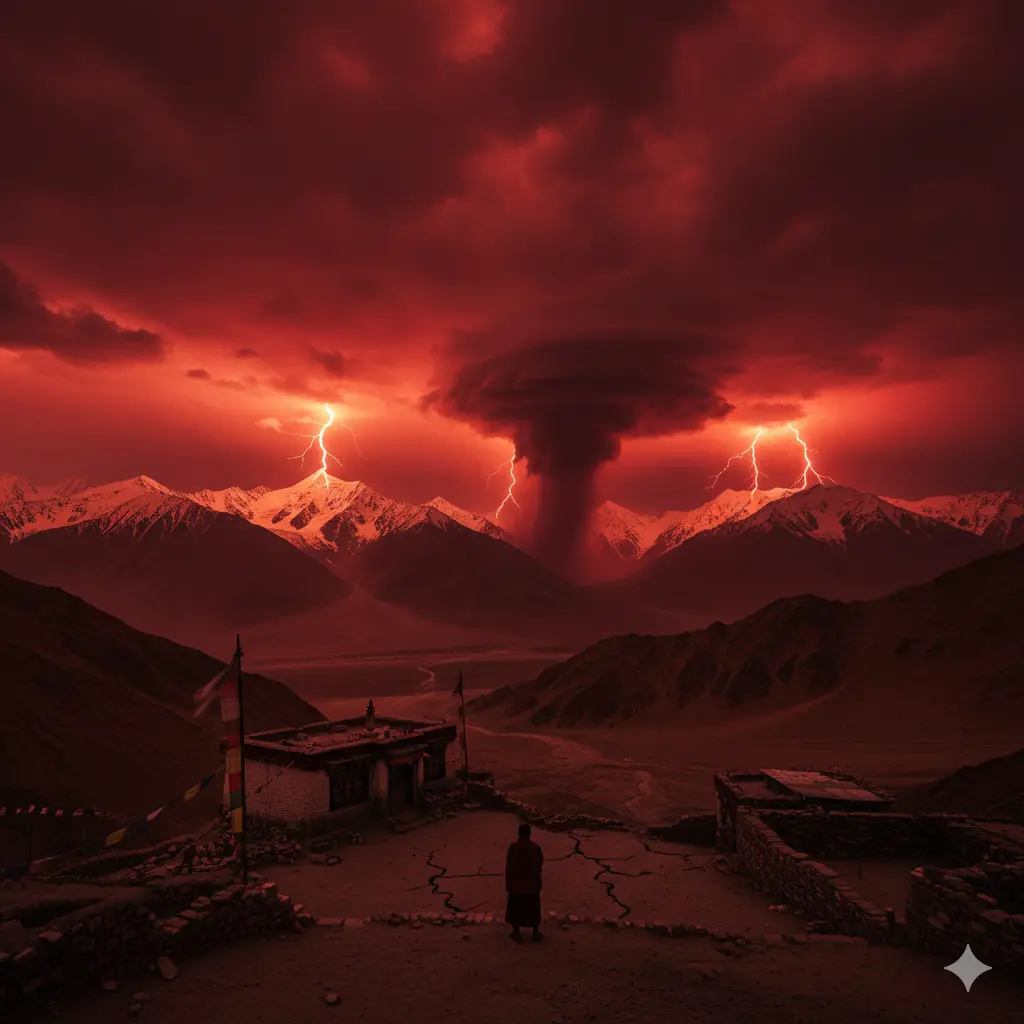
Leh, February 2, 2026 -The faultless skies that enveloped Ladakh on Sunday night of the 19 & 20 January burst into a strange blood-red light and changed the high-altitude paradise into a doomsday landscape that put locals and tourists in a state of paralysis of astonishment and terror. There were selfie posts under the crimson dome like wildfire and scientists blasted it as a chilling omen of killer dust storms, flash floods, and climate disaster in the fragile Himalayan cold desert.
Nubra Valley eyewitnesses reported that the sky seemed to have ignited, at about 7 PM, and coated snow-capped mountains in apocalyptic red for more than 2 hours. As in the volcano scene of the Bollywood, but in reality, said pony safari guide Tashi Dorje of Diskit, but it was in reality, and frightening. The Pangong Lake campers filmed time-lapses of the blazing colours vibrating in frozen lakes that amassed 5 million X views. Tourists have referred to it as the nature-aurora but the India Meteorological Department (IMD) ruined the romance by vindictively scattering Saharan dust particles through cyclones over the Arabian Sea, which were enhanced by western disturbances, to create the optical freak show.
Dust Storm Warning: Red Sky Presents Hell.
IMD Leh Director Romila Bharadwaj cautions against this not being an Instagram flex, however, this red sky is screaming danger. Great loads of dust (PM2.5 levels soared to 450 µg/m 3 20 times the safe limit) are a harbinger of vast sandstorms in the middle of the week, just as the Hoshangabad blackout of 2024 claimed 12 lives. “Dust is stealing the sunlight, overheating the ground, 50kmph winds will blow, no visibility on the highway of Leh-Manali, be careful,” she warned. The risk of flash flood increases when the melting glaciers are combined with dust-filled clouds, and the Shyok River of Nubra might rise 3 meters.
Climate gurus point blame at artificial havoc: the shrinking glaciers of the Himalayas (shed 40% ice since 2000) leave dust bowls in their wake, and the dust is funnelled upwards by the burning of stubble in Indo-Gangetic areas. Ladakh subsidises the pollution in Delhi, Dr Anjal Prakash says: red skies Red flaggle tipping point. These are seeded by satellite tracking that indicates the growth of the Thar Desert over 2,000 sq km each year.
Local Panic: Tourism vs Survival.
Leh is full of panic shopping for N95 masks and emergency kits. ITBP puts up oxygen reserves and is worried about the peaks of altitude sickness. Brokers call off treks; Ladakh Autonomous Hill Development Council encourages 3-day inventory. Beauty murdered my bookings,” says homestay owner Padma Yangdol with a 80% decline in occupancy.
To the adventure enthusiasts of Haryana who have plans in their minds to buy summer bikes to Khardung La, cancel, IMD predicts that there will be a Category 3 dust storm until the 5th of February. New ₹500 crore Ladakh green push (wind farms, afforestation) by the Modi govt is a band-aid on a bullet wound amid the China border chill.
Red sky at morning, wayfarer beware, Lovely Ladakh is preying wrath. Heed it, or pay the price.