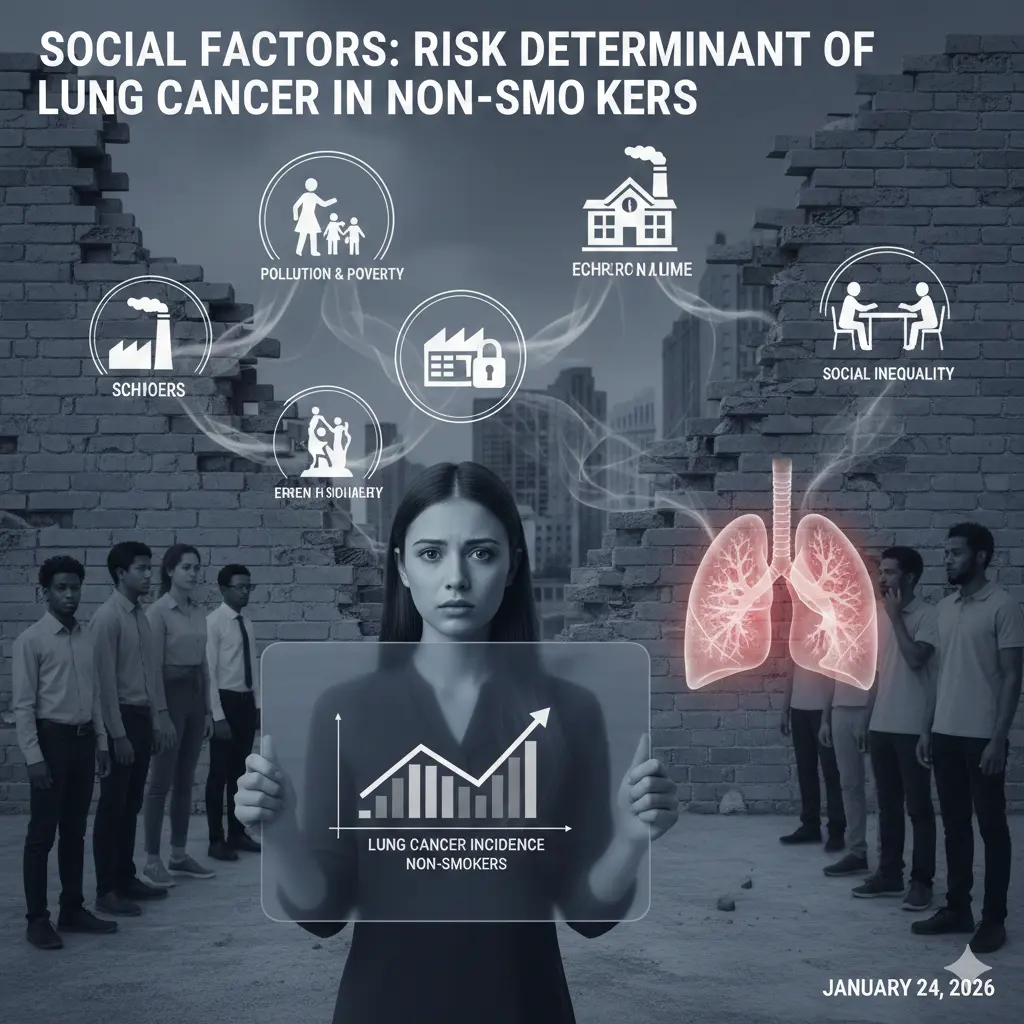
The environmental and social factors, too, are also regarded as a significant cause of the heightened risk of lung cancer in persons who have never smoked, and chronic lung disease and low socioeconomic status may be mentioned as the most important factors. A major Korean study of 3, 000 never-smokers with non-small-cell lung cancer (NSCLC) found that such factors increased the odds two or three times, and implied that the wide-scale screening should be carried out regardless of the tobacco history.
Top of the List: Chronic Lung Disease.
The most important predictor that was adjusted was chronic respiratory diseases including COPD or asthma with an adjusted odds ratio (aOR) of 2.91. Median age of 60, Stage I NSCLC was the most common out of 81% female cohort presentation with 66.7 predominant although underlying lung issues aggravated the susceptibility.
In the cases and controls, there was a matching of chest CT scans from 2016-2020 in the tertiary centres. This kind of association suggests that inflammation is already present, or there is a malfunction in its clearance which makes the cells more vulnerable, whether the individual has been exposed to smoking or not.
Socioeconomic Inequality encourages high odds.
The lack of better access to healthcare and pollution load was experienced in non-capital region living (aOR 2.81). Odds were found to be 32 times higher in the case of unemployment (aOR 1.32), but higher education decreased the risks by nearly half (aOR 0.53), which revealed knowledge gaps in prevention.
Small upliftment (aOR 1.23) was caused by family history, but not mediated by mutation selection. The situation in the rural areas was worsened by dust, biomass fuel, and the lag in diagnostics, in line with the tendencies of the whole world in Asia.
Complexity: Lifestyle Layers.
The independent predictors of incidence were reduced BMI, exercise, alcohol intake and excessive intake of meat among non-smoking Korean women. The obese tragedy was turned upside down in this instance whereby the skinny persons were 33 times more prone to be at risk of frailty or a silent problem.Radon, air pollution and secondhand smoke are guilty but the social gradients augment them. This is shown in the literature of Western countries: the Canadian statistics linked low risk to poor dieting and inactivity in never-smokers.
Trends in the World and the City-Country Meridian.
Never-smoker lung cancer is the most prevalent type of lung cancer now 10-20% of the cases in the world that is more likely to occur among women of East Asia due to cooking fumes and genes. According to the US statistics, the presence of an onset of NSCLC among young people exists at an early age and is linked with toxins and stress in the neighbourhood.
The UK Biobank study is founded on modifiable habits like physical inactivity that attributes it to poor lung functionality that foretells ttumourdevelopment. Reports of mysteries are boosted throughout the globe, and the molecular subtypes are not equivalent to the profiles of smokers.
Demand Inclusive Screening.
The current programs that are being used to address smokers are excluding these risky groups. Multifactorial models such as the SES, lung history, and family ties could be used to increase the eligibility of low-dose CT and at an early stage to identify Stage I.
The public health should address root causes: less polluting fuels and work, and education. Cancer prevention turns into the battlefield of social justice because an increasing number of cases of never-smokers can be observed.