SC’s new definition of Aravalli triggered mass protests countrywide.
In a recent hearing, the Supreme Court of India gave a new definiton of the Aravalli hills which triggered widespread protests across Haryana ,Rajasthan and Gujarat with environmental activists fearing the new definition could change the dynamics of one of the country’s oldest mountain ranges. The new definition states that, an “Aravalli Hill” is any landform in designated Aravalli districts with an elevation of 100 metres or more above its local relief” and an “Aravalli Range is a collection of two or more such hills within 500 metres of each other”. The aim of this definition was to provide clarity and objectivity in regulating activities like mining across the Aravalli landscape.
Significance of Aravalli range
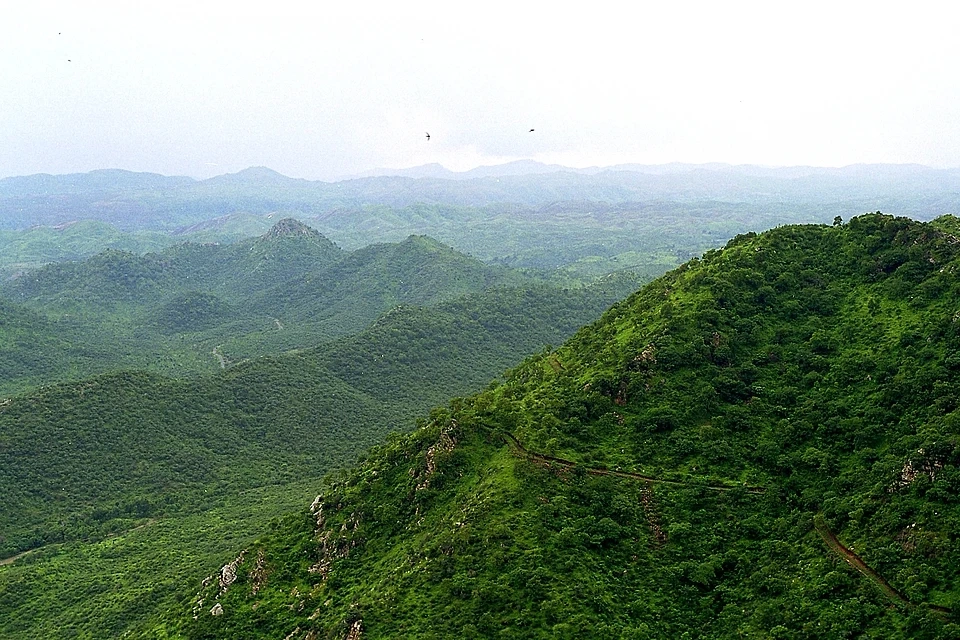
The Aravalli hills are nearly two billion years old and India’s oldest mountain range. It stretches over 692 kilometres (430 miles) in a northeastern direction covering the Indian states of Haryana, Rajasthan and Gujarat and Union Territory of Delhi. Rajasthan accounts for nearly two-thirds of the mountain range. They serve as an important ecological barrier to prevent the desertification of the Indo-Gangetic plains. These ranges help in preventing the expansion of the Thar Desert into Haryana, Rajasthan and western Uttar Pradesh, and play a major role in stabilising climate, supporting biodiversity, and recharging groundwater. Aravalli mountains are a source of rivers like Chambal, Sabarmati, and Luni. It is also rich in sandstone, limestone, marble, granite, and minerals such as lead, zinc, copper, gold, and tungsten. The Aravalli range houses UNESCO World Heritage Sites like Chittorgarh and Kumbhalgarh forts. India has also undertaken international commitments, under the UN Convention to Combat Desertification, to protect vulnerable ecosystems such as the Aravalli range.
The highest peak of Aravalli range, Gurushikhar (1722 m) is situated on Mount Abu in Rajasthan. It is home to 22 wildlife sanctuaries and three tiger reserves, and provides habitat for endangered species such as the tiger, leopard, Indian wolf, sloth bear, and Great Indian Bustard. Aravalli is also home to major religious centres such as Pushkar, Ajmer Sharif, Mount Abu, and Ranakpur, making it sacred to Hindu, Islamic, and Jain traditions.
Criticisms of the New Definition of Aravalli Hills
- Majority landscape is being excluded: the 100 meter threshold will lead to the exclusion of about 90% of the Aravalli system. Since Aravallis acted as a natural barrier for Delhi- NCR region against the pollution, this will now pose significant threat to the air quality control management in Delhi NCR.
- Expansion of Mining: areas falling outside the definition will become open to mining, construction and urabanisation.
- Lower groundwater recharge: Lower hills and slopes are crucial for rainwater percolation and aquifer recharge, their disturbance could affect the water table beneath, ulitmately leading to water crisis in the adjoining regions.
- Desertification: this can lead to sand and dust entering further inside India leading to desertification.
- Enforcement challenges: new definition may create regulatory loopholes, making illegal mining harder to curb.
Way Forward: measures to protect Aravalli range
To protect and save Aravalli hills from illegal mining activities apply graded and risk-based controls on such activities, supported by clear criteria for prohibition, regulation, and monitoring. Strengthen monitoring and surveillance on the illegal mining through institutional coordination. Use of drones, satellite imagery, CCTV, e-challans, and district task forces will enhance the early and easy detection process. Restoring the Aravalli ecosystem is vital to protect water regulation, biodiversity, climate resilience, and to meet India’s commitments under the Paris Agreement, Bonn Challenge, and Land Degradation Neutrality, while safeguarding local livelihoods and flora and fauna. Aravalli range is a life-support system for north-western India, the goverment must act wisely to preserve one of the oldest mountains of India.