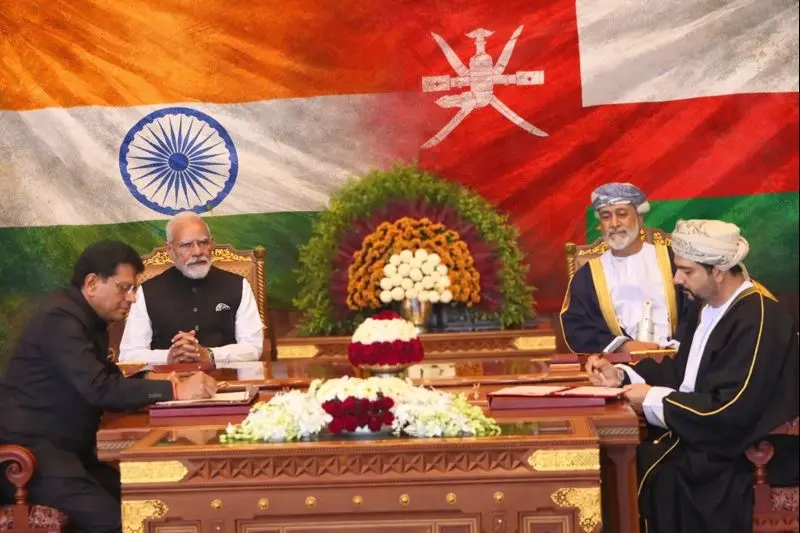
Deal locked in Muscat by Commerce Minister of both the countries.
Prime Minister Narendra Modi’s three-country tour ended in Oman on Thursday by signing a trade pact for duty-free exports. This is the second Free Trade Agreement signed in the last 6 months after the United Kingdom. India’s Commerce and Industry Minister Piyush Goyal and Oman’s Minister of Commerce, Industry & Investment Promotion H.E. Qais bin Mohammed Al Yousef signed the agreement in the presence of PM Narendra Modi and Sultan Haitham bin Tarik. Oman has offered zero-duty access on 98.08% of its tariff lines, covering 99.38% of India’s exports to Oman. Major sectors such as gems and jewellery, textiles, plastics, furniture, agricultural products, pharmaceuticals etc. will receive full tariff elimination. India in turn, is offering tariff liberalization on 77.79% of its total tariff lines (12556) which covers 94.81% of India’s imports from Oman by value. India has secured a second deal with a country in Gulf Cooperation Council (GCC), the first being United Arab Emirates (UAE) in February 2022. CEPA will pave the way for new employment opportunities and innovation for the youth of both countries.
Few areas like agricultural products, including dairy, tea, coffee, rubber, and tobacco products; gold and silver bullion, jewellery; and other labour-intensive products such as footwear, sports goods; and scrap of many base metals have been kept out of this deal to safeguard India’s interest. A major highlight of the CEPA is the enhanced mobility framework for Indian professionals. There will be a notable increase in the quota for Intra-Corporate Transferees from 20 per cent to 50 per cent, with a longer permitted duration of stay for Contractual Service Supplier which has been extended from the existing 90 days to two years, with the possibility of a further two-year extension. The entry and stay conditions has also been liberlised for skilled professionals in key areas such as architecture, accountancy, medical and allied services and taxation. CEPA becomes even more crucial amid uncertainties in India–US trade.