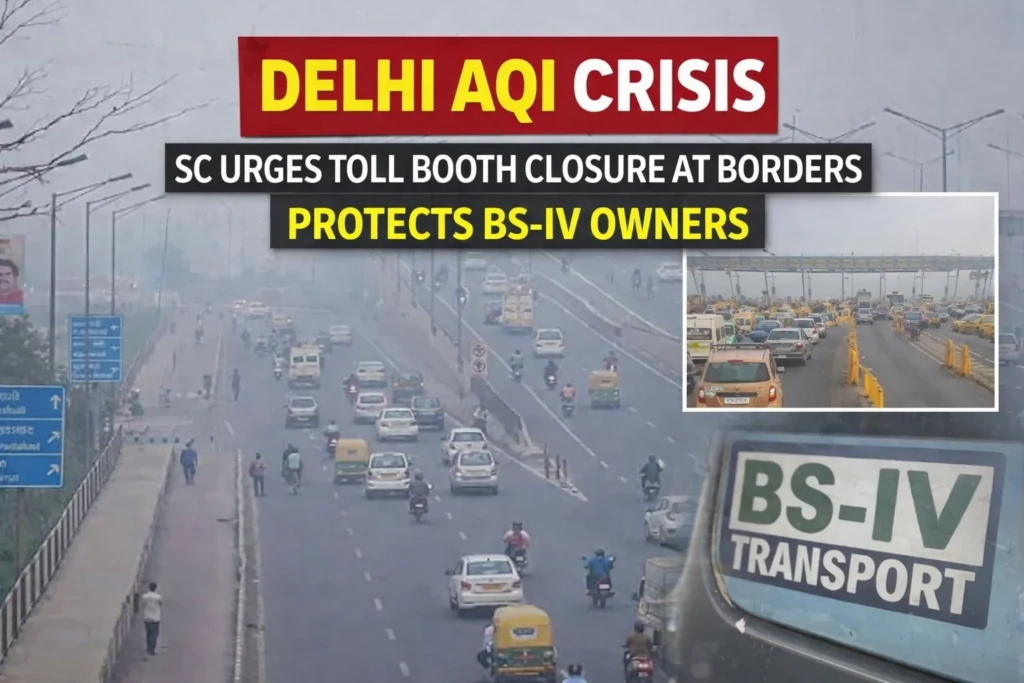
The Supreme court of India has given significant rules to resolve the air pollution issue in the Delhi-NCR in which case, the Delhi government has been counseled to give thought to suspending the gathering of the tolls at the entry points without exception of the BS-IV vehicle owners who are liable to tough measures. The moderation approach would avoid congestion of the traffic without taxing those that abide with the commuting unfairly.
The Court Directives on the Pollution Control.
Justice B.V. Nagarathna who presided over the bench noted that there should be humane enforced during winter peaks of pollution. It did not censor or even intimidate BS-IV diesel automobiles because it could value the investments made by the owners and the financial strife of scrappage. Instead, the court directed it to be tighter in inspection and GPS tracking of diesel commercial vehicles entering Delhi based on the compliance certificate or pollution under compliance certificate or PUC.
The government is supposed to outlaw the overage vehicles but not the BS-IV automobiles, there would only be fines imposed on the habitual offenders. The court also supported expansion of odd-even scheme and use of construction dust control and efficacy of the prior stages of GRAP (Graded Response Action Plan).
Rationalizing behind Underlies Toll Booth Suspension Concept.
Tolls at Delhi like Singhu and Ghazipur are usually very discouraging to the significant travels, thereby escalating congestion and air pollution by stagnant traffic. At least a temporary waiver offered by the Supreme Court would contribute to the easing of traffic circulation, which can reduce pollution by 10-15 per cent, since the waiting time will be reduced. This is the case in 2023 wherein in case of a crisis the tolls were being canceled so that it did not put a strain on the population when it comes to using the public transport.
The order goes hand in hand with the court prodding of preventive as opposed to punitive action that condemns arbitrary vehicle bans, which affect the middle classes the most. Statistics reveal that BS-IV cars make up 40 percent of the Delhi fleet, which means that it is impossible to coerce the blanket level without another option like EV-subsidies.
Expansive Capacity of Delhi Air Crisis.
During winters, due to stubble burning, vehicle emission (30 percent of the total) and industry, the Air Quality Index (AQI) of Delhi tends to exceed 400. GRAP-IV has prohibited non-essential diesel-drunken vehicles that are more than 10 years old and the National Green Tribunal (NGT) and the Supreme Court have interfered in a number of occasions. The recent petitions noted the impact of border tolls in the rising queues of 5-7 km/l in fuel efficiency.
The court was linked with the pollution and health crisis because 2 million deaths annually in the country because of the bad air affected the country. It coordinated the activities of Delhi, Haryana, UP, and Rajasthan to collaborate (including 50 percent work-from-home mandates and school closures in event of AQI exceeding 400).
Implications to Vehicle owners and Government.
BS-IV owners are excused on the spot, they do not have to pay a fine, impound or a ban of entry without failing PUC. It secures 10 lakh and above vehicles against demonstrations that was experienced in the past crackdowns. The idea of implementing the toll suspension may save commuters 100-200 a day and redirect the funds at the environmentally friendly initiatives like metro construction.
The governments are pressured to back down in 48 hours and the court reviews are fixed. Critics are adamant that the waiving of the tolls would reduce the revenue (₹ 500 crore per year), but those in favor of it argue it is worth the fresher air. The order promotes the use of CNG and parking lots in the border in the long term.
Reactions of a political nature and public reactions.
Environmentalists rejoice in the subtle position which they call pro-poor pollution control. The AAP party ruling in the Delhi govt took the concepts of toll relief blaming the surrounding states of setting fire to farms. BJP was against this citing that central GRAP implementation is central and stubble solutions are urgent.
Commuters claim to have less fears and cab unions are considering PUC camps. The decision has enhanced judicial activism in federal pollution fights and will result in further interventions in future since AQI is still at 350 and above. This would set a precedent to other metros like Mumbai and Bengaluru which are at the same price.