Bill sparks debate in the Lok Sabka; opposition raises several questions.
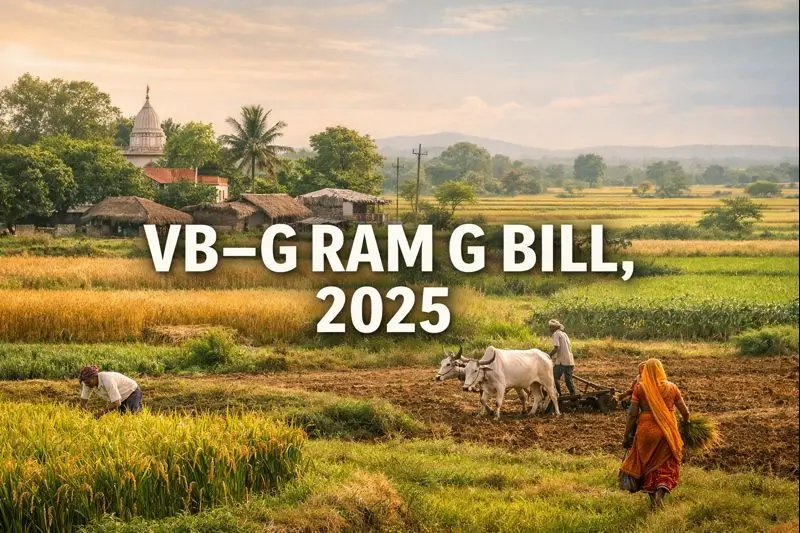
The ruling government is set to replace the Mahatma Gandhi National Rural Employment Guarantee Act 2005 (MGNREGA) with Viksit Bharat—Guarantee for Rozgar and Ajeevika Mission (Gramin) VB—G RAM G BILL, 2025. The proposed legislation will increase the workdays from 100 to 125 days in a financial year and employment will be provided only in rural areas as notified by the centre. The bill was circulated to MPs by the government on Monday. It focuses on empowerment, employment generation and inclusive growth. While the earlier scheme i.e. MGNREGA was fully funded by the central government, the recent scheme will put more financial burden on the states as the cost will be shared in 60:40 ratio between the centre and the states. Whereas, fund-sharing pattern between the Union government and the State governments shall be 90:10 for the North-Eastern States, Himalayan States/Union Territories (Uttarakhand, Himachal Pradesh, and Jammu and Kashmir).
MGNREGA, 2005
The act was launched in 2005 as a centrally sponsored scheme to provide a minimum of 100 days of unskilled manual work to an adult member of an eligible rural household. To be eligible for this scheme, a person must be a citizen of India, his/her age must be 18 years at the time of application, he/she must belong to rural household and willing to do unskilled labour. It also resrves one third of the jobs for women, promoting gender inclusivity. If work is not assigned within 15 days, then the person receives an unemployment allownace. The work is usually provided within a 5 km radius and beyond that travel allowance is provided to the worker. Implementing agencies are responsible for providing proper working conditions, medical facilities, and compensation.
VB-G RAM G BILL
The VB-G RAM G Bill has been introduced in Lok Sabha during the Winter Session this year, which proposes various provisions. It aims to make wage payments faster, plan resources better, and ensure work is available when needed, while also supporting farmers during busy agricultural seasons. The bill replaces the MGNREGA, 2005 and will provide 125 days of work every year. It ensures faster payment by paying workers every week to make income timely and reliable. Under this scheme, both the centre and the states will share cost, making it more sustainable. It will stop work during peak agricultural season so that the farmers have enough labour to meet their work demands.
Key changes under the bill
- The Centre will determine a state-wise normative allocation for each financial year, any expenditure exceeding the allocation must be borne by the respective state government.
- Northeastern & Himalayan States, and certain UTs: 90:10 Centre-State share
- Other States with Legislature: 60:40 Centre-State share
- UTs without Legislature: Centre bears the full cost. (Under MGNREGA, Centre funded the entire wage bill.)
- Employment will be paused for 60 days during peak sowing and harvesting season, where the states will notify these periods based on the local farming patterns.
- It will provide weekly payments to workers unlike MGNREGA which has a 15-day payment limit.
What next?
The bill has already been circulated among the MPs on Monday, it will now be discussed in both Houses of parliament. Once debated, it will be put to vote in Lok Sabha and Rajya Sabha. If passed by both the houses, it will be sent to the President for assent to become a law. The Centre is likely to notify the implementation framework and guidelines for states. States need guidance to manage their share of funding without affecting work availability. The scheme is likely to be implemented in phases beginning from the next financial year.